
Say the man in 4B tells you the fire bell in your building will be tested once this week, on a morning you won’t see coming.
Not “perhaps”. It will ring, and it will catch you out. So you start crossing off days on the back of an envelope.
Friday is the last morning it can ring, so by Thursday night you’d be certain, so Friday is out. Then Thursday goes, for the same reason. The argument eats the whole week.
Some dread is just the mind swapping “sometime” for “Thursday”. A bad date is easier to carry than no date.
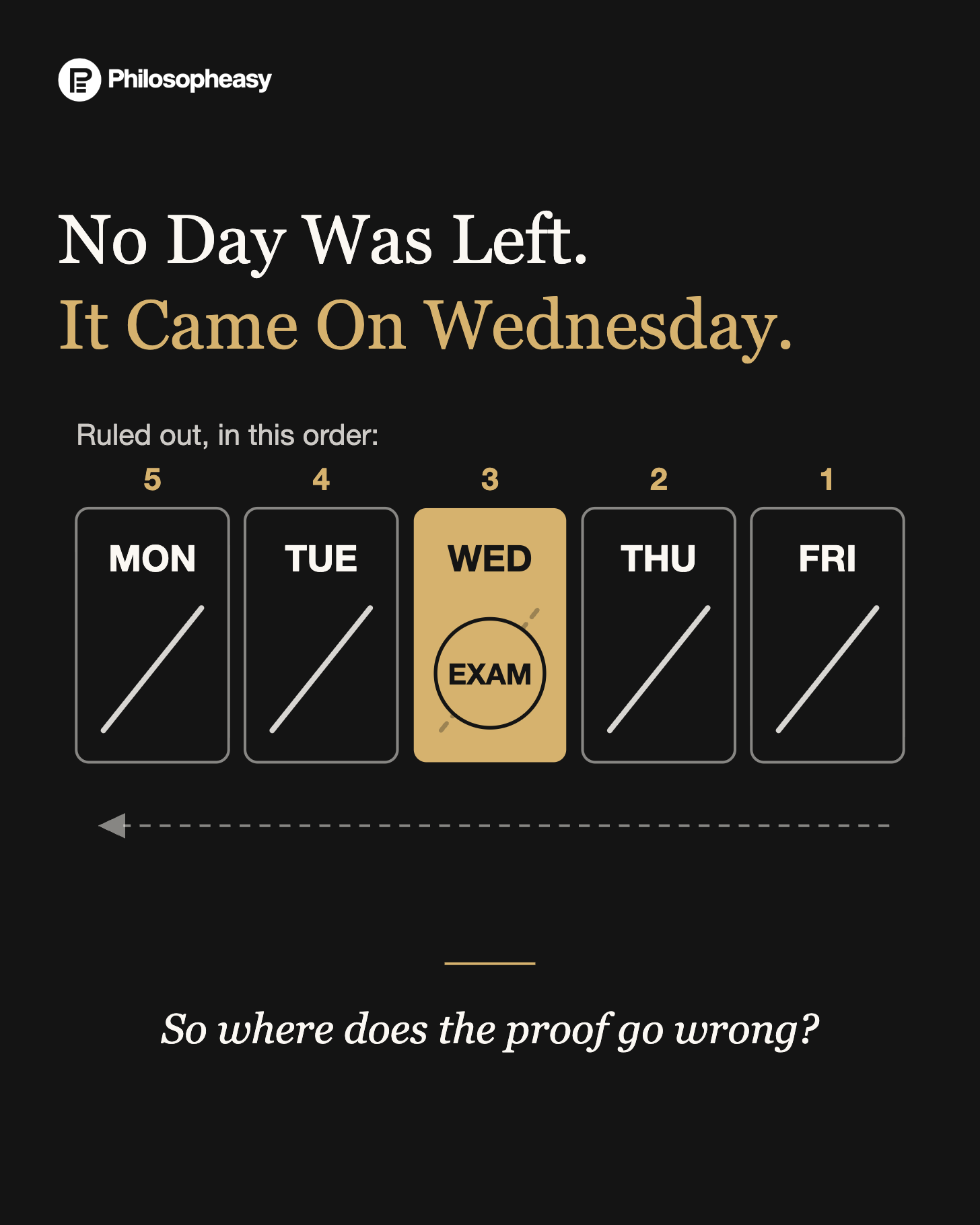
Then the bell rings on Wednesday and you jump. That jolt is the puzzle. Your proof left no mornings, and one turned up anyway.
This is the surprise examination paradox, also told as the unexpected hanging. This article is the companion to the video. Below the line: where the puzzle came from, what it’s good for, three habits for the waiting, and Simone Weil.
The student reasons fine. The trouble is that her proof needs her to be sure of a promise that says she can’t be.