


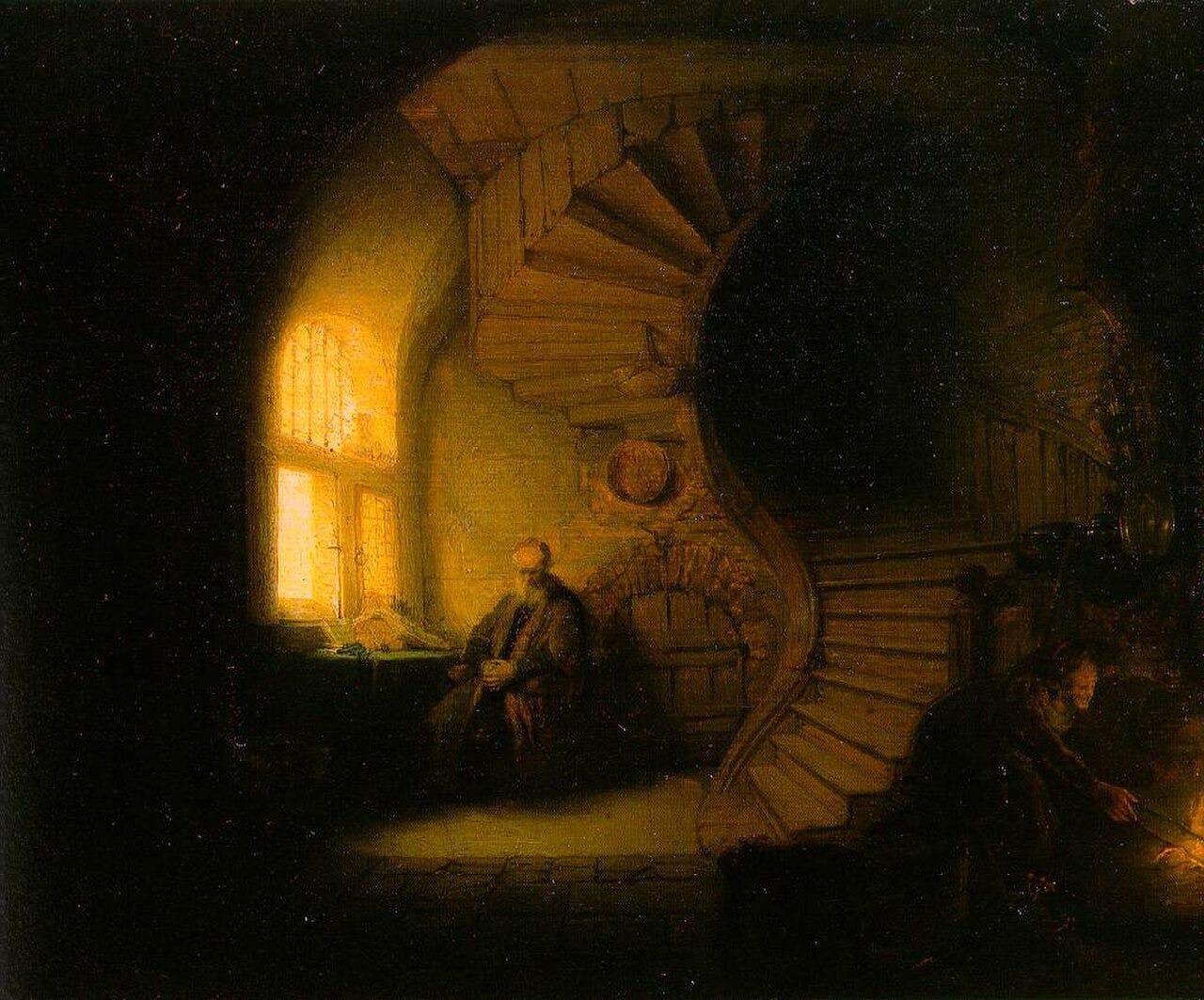
Listen first. This week’s episode, above, tells the whole story. This page is the companion.
The lift doors close and you’re alone. You take out your phone. Nine floors, maybe twenty seconds, and nothing on it was something you needed.
Nobody in that lift was busy. They just couldn’t stand twenty seconds of nothing.
The odd part is the order. The hand goes first and the thought catches up. Catch it once this week and you’ll feel a small lurch just before, like missing a stair. This page is about that lurch.
The idea in brief
Pascal had a word for the reach: divertissement. In ordinary French it means amusement. In the Pensées, his unfinished notes on human nature and faith, it means diversion in the literal sense: whatever turns our attention away from our own condition.
He looked at kings, the people with the best excuse to rest, and noticed that their courts are built so the king is never left alone with himself. There is always a hunt, a game, a petition, a companion at the elbow. Pascal’s point was that the king needs all of it. So the busyness is not a flaw of yours. It is old, and it is shared by the people we would expect to be free of it.
A packed diary is a respectable way of never being in.
He thought the trouble was the room, because of what’s in it: we are breakable and we die. The audio goes there, mortality first, and I will not repeat it here. This page is for the moment the urge arrives.
Why a companion
Audio is good for the argument. It’s no use at 6.40 on a Tuesday with your hand already on the dishwasher door. For that you need something to look at and something to do.
So this page holds three tools. The first is a 10-minute empty-room practice you can run tonight, with no other reading. The second is a test for telling “this needs doing” from “this keeps me from thinking”. The third is a weekly prompt for the question your busyness may be covering.
A task can be necessary and a hiding place both. What matters is why you’re doing it now.
Below, for paid subscribers:
The 10-minute empty-room practice, step by step, including what to do with the urge to add a task
The “needs doing” versus “keeps me from thinking” test, in three questions
A table mapping common reaches to what they may cover, with a first move out of each
Pascal set beside this month’s usual advice on rest and switching off
A 7-day journal with one prompt a day, ending in your weekly prompt
Where to read Pascal next


