


For most of this autumn I figured that a question I couldn’t answer meant I hadn’t thought hard enough. So I kept sitting down at the kitchen table to think harder. Each time I got up with the same blank and a sourer mood.
Then I ran into an argument about twenty-four centuries old, and the blank started to look less like my failure and more like a puzzle other people had also sat in front of.
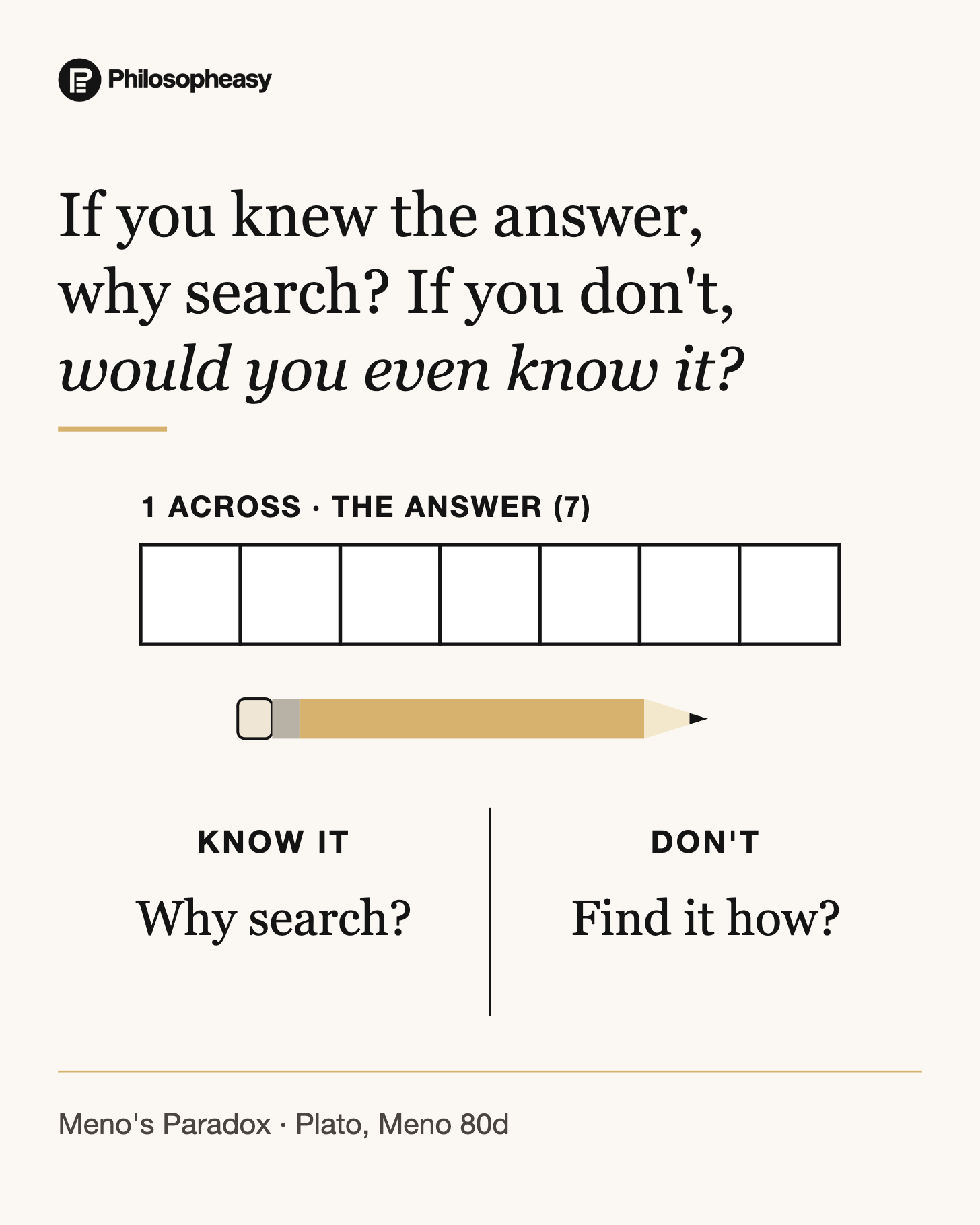
The puzzle has a definite shape, and Plato wrote it down. It was written down in Plato’s dialogue the Meno, composed in the early fourth century BCE. Meno, a visitor from Thessaly, asks Socrates whether virtue can be taught, and Socrates replies that he doesn’t even know what virtue is. Meno answers with a trap (Meno 80d).
You cannot search for what you know, because you have it already, and you cannot search for what you don’t know, because you wouldn’t know what to look for.
Socrates calls it a contentious argument, a debater’s trick that helps nobody. Still, he doesn’t brush it off. He answers it with a story.
What Plato Actually Did With It
The story is recollection. Socrates claims the soul has learned everything before birth, so learning is remembering. To show it, he questions a boy from Meno’s household about doubling the area of a square (Meno 82b to 85b).
The boy says the side should be doubled. Wrong, and Socrates shows him why. He tries one and a half times the length. Wrong again. Then, stuck, he is led to see that the diagonal works.
Hardly anyone now believes in the previous life. The part I keep going back to is the middle. Socrates says the boy is better off after being refuted than before, because he has stopped thinking he knows and now wants to find out.
Later in the dialogue, Socrates adds a second thought. A correct opinion can guide you as well as knowledge can, but it tends to wander off until it is tied down by working out the reason behind it (Meno 97a to 98a). So a guess can be right and still not be yours yet. What makes it yours is the working-out afterwards.
Without the Previous Life
The paradox assumes two options: you know the answer completely, or not at all. Real questions sit between. You know some things about the answer. It mustn’t break a promise I made in March. It has to hold up on a bad Tuesday. It can’t need me to lie to my sister.
That much is enough to search with, and enough to tell when something fits.
An answer you couldn’t have named in advance can still be one you can reject, test and slowly narrow in on.
This is close to what Rilke tells a young poet in the letter of 16 July 1903, in Letters to a Young Poet. He says to be patient with what is unresolved in your heart, to love the questions themselves, and not to chase answers you cannot yet live. The answer, he suggests, comes by living your way toward it. Read next to the Meno, it’s about method as much as comfort. Waiting is how you fill in the middle ground.
Three Things to Try
The refusal ledger. For a fortnight, write down each answer you are offered or tempted by, and one line on why it doesn’t fit. “Move to the coast” fails because it fixes the problem by leaving the people. “Give it another year” fails because it is fear dressed as stamina. After a dozen entries, the reasons start to add up to a rough outline of the answer you haven’t found.
The committed wrong guess. Socrates’ boy had to say something before he could be corrected. Pick the answer you currently lean toward, state it in one sentence, and live inside it for three days as if it were settled. Note where it chafes. Where it chafes tells you things that sitting in an armchair and weighing it never will.
The dated question. Write the question at the top of a page with today’s date, and a sentence on what makes it hard right now. Put it away. Return in a month and write the same two lines again, without looking at the old ones first. Then compare. The question is rarely word for word the same, and the differences tell you whether you’ve moved or only feel stuck.
The Waiting, Again
None of this forces a conclusion. It just keeps the waiting from being blind. A question carried for months has usually been working on me the whole time, and the Meno suggests that counts as searching.
Meno wanted to shut the conversation down. Socrates kept going while saying plainly he was lost, and the boy learned more from that than from any answer.
I’m starting with the refusal ledger tonight, on the back of a gas bill. Reply and tell me which one you’d pick.
Sources:
Plato, Meno, 80d to 86c (the paradox and the geometry lesson) and 97a to 98a (true opinion and knowledge).
Rainer Maria Rilke, Letters to a Young Poet, letter of 16 July 1903, to Franz Xaver Kappus (paraphrased).


