


You tap the small circle next to “meditate for ten minutes” on your screen, and a tiny burst of digital confetti rewards you for successfully executing your mandated stillness. The irony barely registers anymore. You schedule your downtime with the same aggressive optimization you apply to your inbox. The yoga mat is rolled out at exactly 6:45 AM because if it isn’t rolled out then, the window for serenity closes, and you will have failed at resting. You buy bath salts heavily marketed as acts of preservation. You curate playlists designed to artificially induce the slow brain waves you can no longer generate on your own. We treat the recovery from our exhaustion as just another quota to hit before the day actually begins. It is exhausting to manage the cure for your exhaustion.
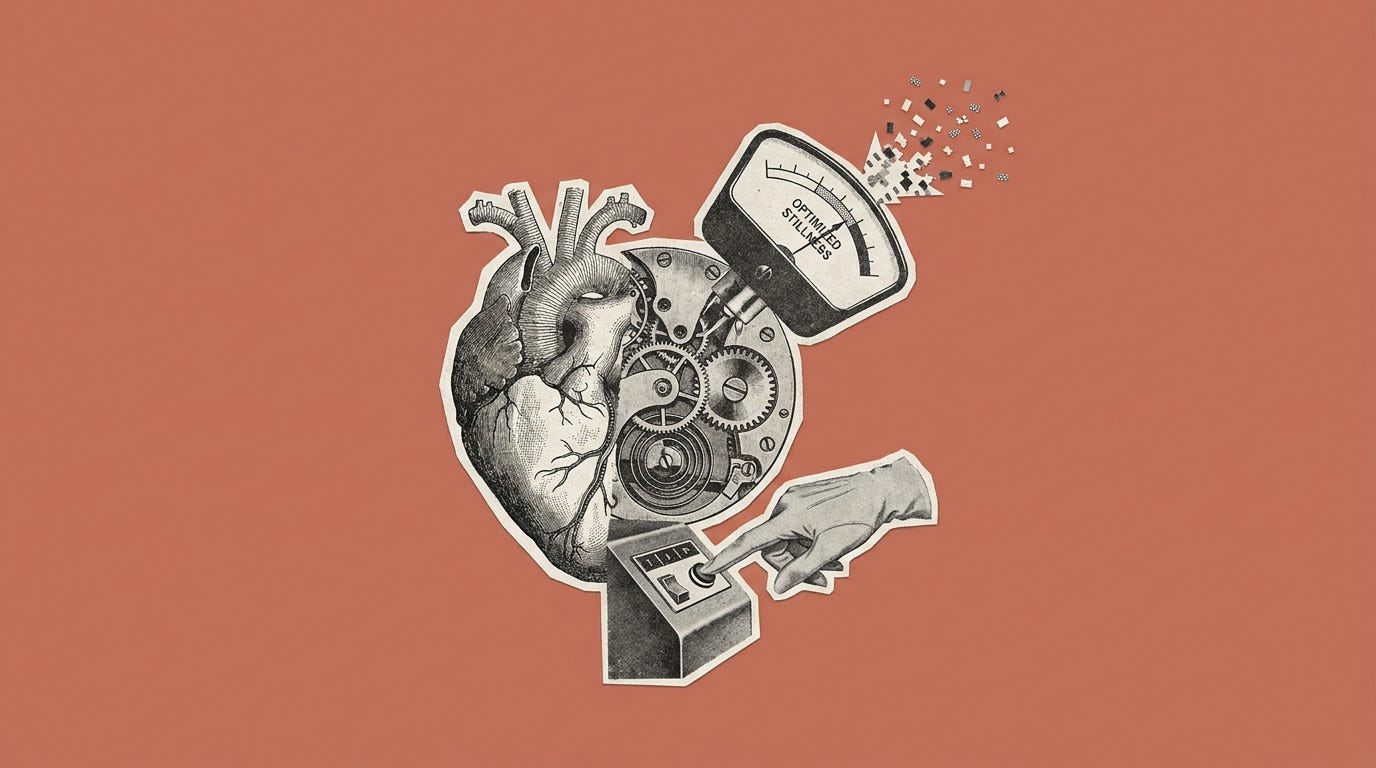
The whole week kept circling one specific knot—we are vibrating with a low-grade dread that we can never quite name, and our primary strategy for handling it is to turn our relief into an administrative task. The ambient anxiety humming in the background of your Tuesday morning commute isn’t a medical condition. It is the logical result of living in an environment that demands constant velocity. We suspect that stepping off the treadmill is the answer. We know the speed is breaking us. But how do you actually refuse the momentum of a culture when the only tools it gives you to rest are just different forms of labor? How do you stop moving when stillness feels like falling behind?
Wednesday’s deep dive pulls apart the exact mechanism of this trap. It asks a question that ruins the appeal of the wellness industry entirely: what if the machinery that grinds you down is the exact same machinery selling you the scheduled, packaged methods for coping with it? The proposition there is that your carefully calibrated morning routine isn’t a rebellion against the demands of the week. It is the necessary maintenance required to keep you functioning on the assembly line. It is corporate efficiency disguised as spiritual awakening. That one’s for members.
Friday’s episode starts from a claim that sounds entirely counterintuitive to anyone holding a calendar full of obligations. It suggests that genuine rest requires a complete surrender of the need to be useful, and that true friendship is the only space left where you are allowed to be entirely unproductive without consequence. It examines what happens when you stop viewing a quiet afternoon as wasted time and start treating it as the only time that actually belongs to you. It is a look at the terrifying vulnerability of simply doing nothing of value.
The mistake is believing that doing nothing is the opposite of work. It isn’t. The opposite of work is doing something that has absolutely no use. As long as you are reading a book to become better read, or walking in the woods to lower your cortisol, or sitting in silence to improve your focus, you are still on the clock. You are still treating yourself as an asset that needs managing, a portfolio of skills and states of mind that require constant balancing. You have internalized the manager.
The heavy, dragging fatigue you feel on a Thursday afternoon is not a failure of your endurance. It is not a sign that you need a better sleep supplement or a more rigorous time-blocking system. It is the entirely rational response of a human being asked to extract value from every waking minute.
The radical move is not to find a more efficient way to recharge. It is to deliberately, consciously waste time. To sit on a bench and refuse to process the experience into a life lesson. To watch a bad movie without ironically critiquing it. To spend two hours talking to a friend about absolutely nothing that matters, and to recognize that those two hours are the only part of the week that cannot be put on a spreadsheet. Value is the trap. The moment you demand a return on your investment of time, you have turned your life into a transaction.
If every hour is accounted for, who actually owns your days?
Members get the Wednesday deep dive, the Friday episode, and the full archive—and over a few weeks, a working set of tools for thinking clearly about attention, speed, and modern life.
