
There was a morning, not long ago, when you had nowhere to be.
Maybe it was the first week of the remote job. Maybe you’d just gone freelance, or the project had finally shipped, or the house was empty for once. Whatever it was, you woke up and nobody needed anything from you until the afternoon.
You made coffee. You sat down. And within four minutes, without deciding to, you were holding your phone.
By nine, you knew what three strangers thought of a film you hadn’t seen, what a founder you’ll never meet eats for breakfast, and which morning routine you should probably be following instead of this one.
The morning was still free. You just weren’t in it anymore.
The strangest kind of tired
We usually call this burnout, but it isn’t. Burnout comes from too much being asked of you. This comes from too little. It’s the flat, slightly guilty feeling of having exactly the freedom you wanted, and not knowing what to do with it.
The usual cure makes it worse. Build a routine. Find your why. Optimize your mornings. Each one is another set of instructions, and you follow it, and you end up with a tidier version of the same emptiness.
A book from 1941
Erich Fromm saw this coming more than eighty years ago. A psychoanalyst and philosopher who fled Nazi Germany, he published Escape from Freedom in 1941, trying to understand why people who had won their freedom kept rushing to give it away.
His answer starts with a distinction. There is freedom from: the old ties falling away, the boss, the fixed routine, the place in the world someone else decided for you. And there is freedom to: actually living as yourself, thinking your own thoughts, wanting your own wants.
We’re good at the first. But freedom from leaves us alone with our choices. And alone, Fromm says, we get anxious. So we look for somewhere to put the freedom down.
The most common place, he thought, is simply the crowd. In his words, the person “ceases to be himself; he adopts entirely the kind of personality offered to him by cultural patterns.”
Fromm was describing something far darker than a phone. But the mechanism is the same one that took your free morning.
You didn’t lose it. You gave it back.
Here’s the reframe, and it changes everything about that morning.
Nobody took your freedom. You handed it over, quietly, to the feed, because an open morning, alone with yourself, is frightening in a way we rarely admit. The feed is a very comfortable boss. It never runs out of instructions, and it never asks what you actually want.
That’s not a character flaw. Fromm saw it as a normal human response to a real fear. But once you can see it, you can start to choose differently.
One thing to try tomorrow morning
Before you pick up your phone, ask one question: what would I do right now if nobody would ever know?
Then do that, for ten minutes. It doesn’t have to be impressive. Drink the coffee by the window. Write a paragraph that no one will read. Take the walk you keep postponing.
Fromm had a word for moments like this, when an action comes from you rather than from the crowd. He called it spontaneity, and he thought it was the only real way back to freedom to.
On Wednesday
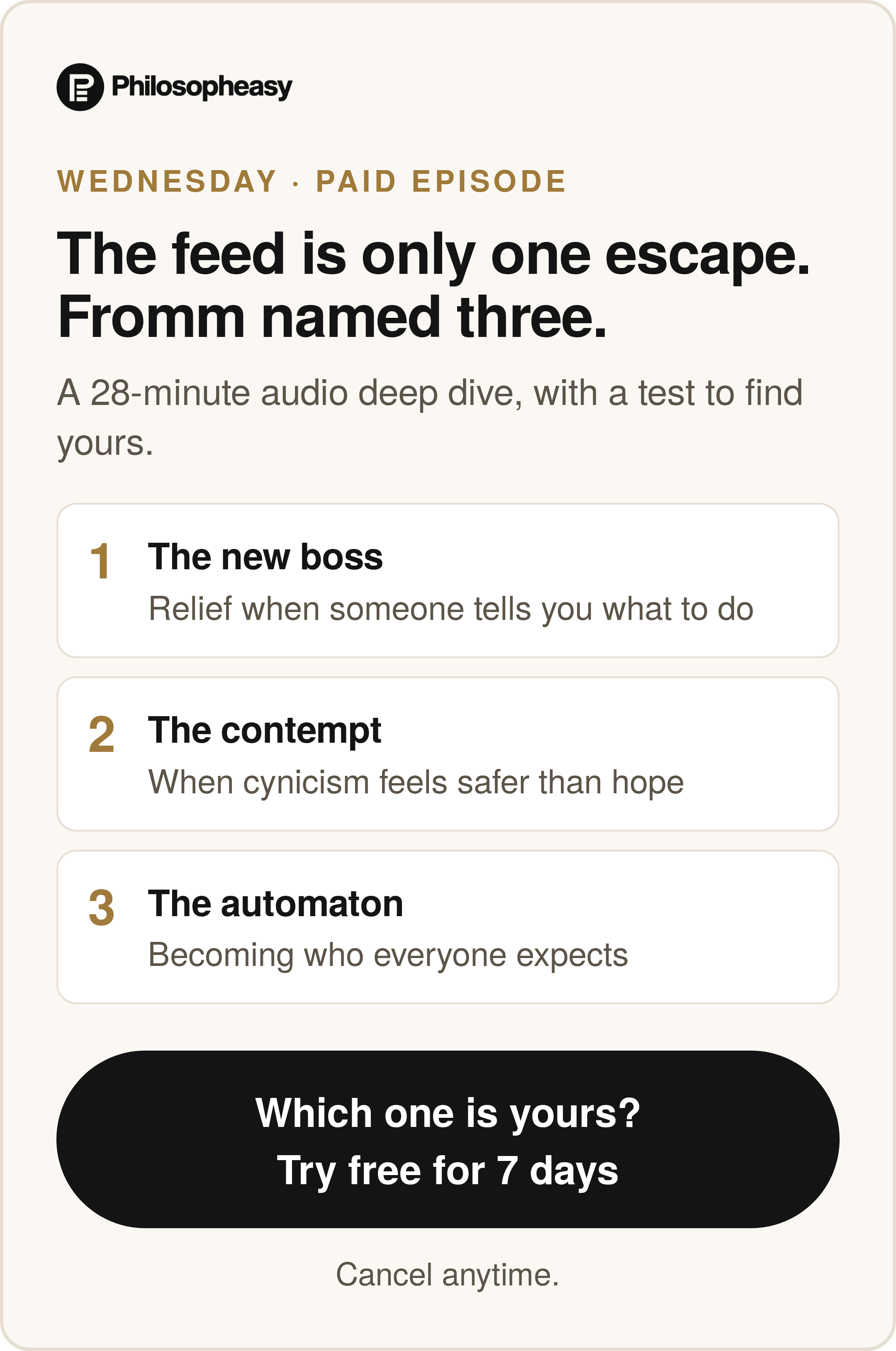
The feed is only one of the ways we hand our freedom back. Fromm named three, and most of us have a favourite.
In Wednesday’s episode, we go through all three: the new boss, the contempt, and the automaton. There’s a two-minute test to find yours, and the practice Fromm says brings you back. Paid subscribers also get the companion toolkit: the Escape Map, Fromm’s key passages read slowly, and a 7-day journal.