


In 1932, as the Weimar Republic convulsed toward its grave, a brilliant, later infamous jurist named Carl Schmitt published a pamphlet-length essay that still haunts political thought. He wasn’t offering a better ideology. He was exposing the skeleton beneath every ideology.
Schmitt claimed that the fundamental political distinction isn’t between good and evil, left and right, or right and wrong — it’s between friend and enemy. A political community, he insisted, doesn’t form around shared values first. It forms around a shared adversary. A group that cannot name its enemy ceases to be political. It withers.
Read that again: your cherished “we” depends entirely on a “them” you are willing to fight and, at the extreme, kill. The subtle dread you feel when a civic debate fails to produce a clear villain? That’s not boredom. That’s the political body starving for definition.
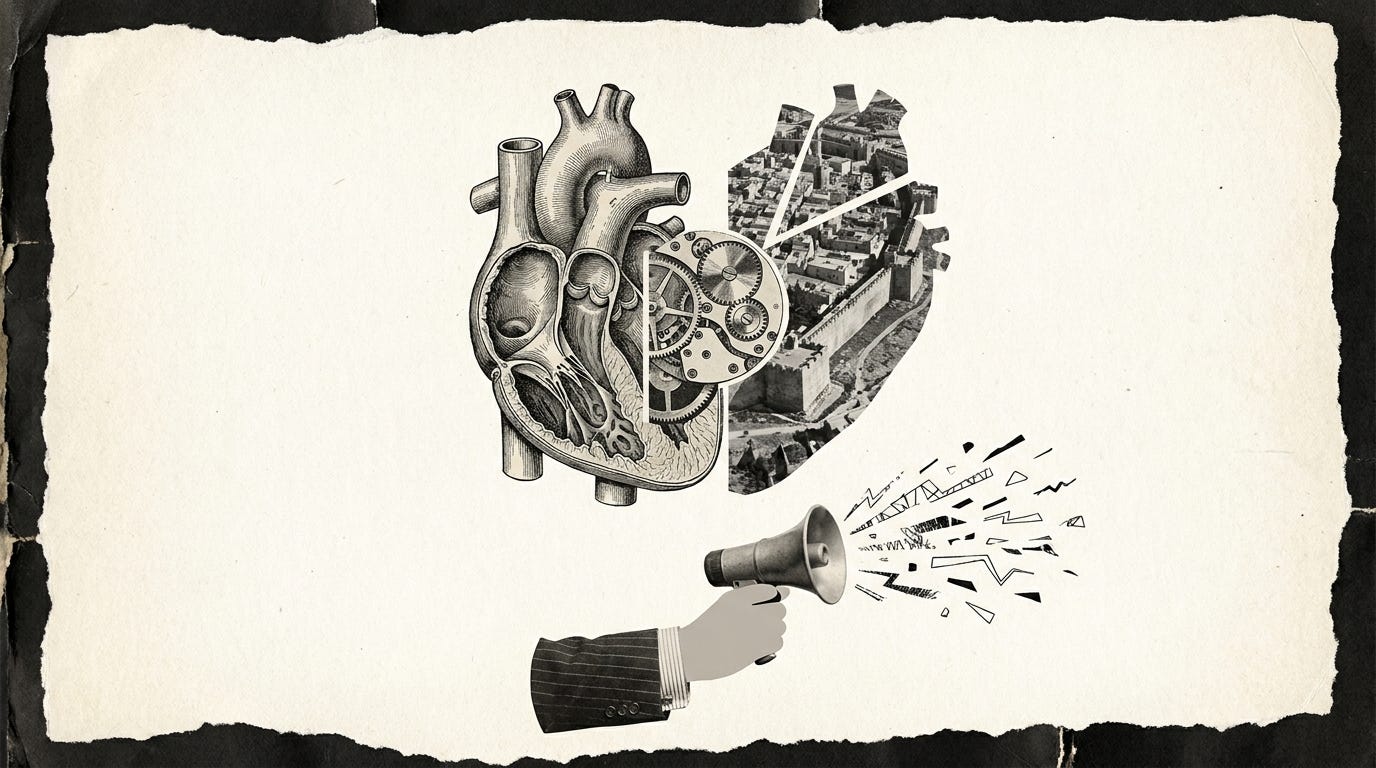
The Ritual of the Enemy
Schmitt’s insight was that politics doesn’t need a rational argument; it needs an existential threat. And that threat doesn’t have to be real — only perceived. This is why your social media feed doesn’t just “show you content you disagree with.” It performs an enemy ritual, refined by algorithms to be frictionless.
Picture a Sunday afternoon at 2 p.m. You open your phone. An algorithm serves you a post from someone whose views you find morally repugnant. The words might read: “If you actually cared about justice, you’d understand X.” You don’t engage intellectually. Your system ignites. Heart rate spikes, jaw tightens, thumbs hover. That sensation — the electric clarity of this person is wrong, we must oppose them — is pure Schmitt. The political moment isn’t about X. X is raw material. The real transaction is identity-reinforcement: your side gains sharper borders by seeing the enemy and feeling the urge to strike back. You might quote-tweet a cutting reply. That public act isn’t persuasion; it’s a territorial bark.
Schmitt called this the friend/enemy distinction, and he saw that it functions independently of issues. Tax policy, pronouns, public health — content is almost interchangeable. What matters is the line. When that line is drawn, your political self suddenly feels solid, righteous, alive. And when the enemy fails to appear — when a day passes without a moral outrage flooding your timeline — something feels missing. The air is too still. Your own convictions feel less tangible. You might even search for friction, subconsciously, to feel real again. The terrifying truth is that your belief system gets its sharp edge not from the coherence of your ideals, but from the presence of someone who would destroy them if they could.
The Addiction We Won’t Admit
The implication lands like a stone in the stomach: the public square isn’t a broken conversation we can fix with better listening. It’s a system that depends on the very hostility we decry. Your righteousness, your outrage, your daily dose of animus — they aren’t by-products of political failure. They are the fuel. Without them, political consciousness fades into private comfort.
Schmitt predicted that modern mass democracies would not civilize the friend/enemy instinct; they would monetize it and smuggle it indoors. And we’ve watched it happen. The culture war becomes a permanent campaign, not because we’re especially divided, but because a decisive victory would leave the victorious identity orphaned. Who would you be if, tomorrow, every person who disagrees with you on a core issue simply vanished? The initial relief would quickly curdle into an emptiness. Your political self would have no shape, no outward tension to stabilize its inner architecture. That Sunday-night unease after a week of furious posting — the whisper that the fight isn’t about winning, it’s about the fight itself — is your body recognizing the game. You don’t truly want your enemies to disappear. You need them to remain a manageable, threatening presence that never quite loses its power to define you.
The feeling that follows isn’t guilt. It’s the cold recognition that you can stop treating your identity like a war.
The mechanism behind this — the part that actually changes how you make decisions — is what we go into on Wednesday. It’s paid. It’s 30 minutes. It’s the reason most people subscribe.
No I’m not
Schmitt explained why we are drawn to enemies. Liberal democracy is humanity’s attempt to live together despite that fact. Social media, by contrast, has discovered that enemies are highly profitable.