


You believe your political views are the product of reason. You read, you listen, you debate, and you arrive at a set of convictions. You chose them.
What if that’s a complete illusion?
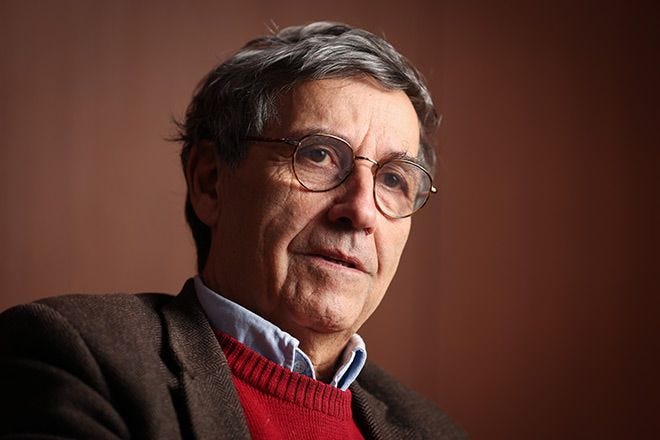
What if your deepest beliefs about liberty, equality, and authority were programmed into you before you could speak? What if they weren’t chosen at all, but inherited, like your eye color or your name? This is the disturbing and powerful proposition of French historian Emmanuel Todd, whose work reveals a hidden code that governs our political lives.
He argues that the true “deep grammar” of ideology isn’t found in economics or philosophy, but in the unwritten rules of the family home.
The Map of the Unconscious
For decades, Todd analyzed centuries of parish records, census data, and inheritance laws. He found that societies are shaped by their dominant family type, defined by two simple questions:
Authority: Is the relationship between parents and children liberal or authoritarian?
Equality: Is the relationship between siblings egalitarian or unequal?
The combination of these answers creates a distinct psychological template. The Anglo-American “Absolute Nuclear Family” (liberty, but inequality) produces a psyche obsessed with individual freedom but indifferent to abstract equality. The French “Egalitarian Nuclear Family” (liberty and equality) forges a culture torn between the twin gods of individualism and absolute fairness.
Meanwhile, the German “Authoritarian Family” (authority and inequality) cultivates a deep respect for order and hierarchy. Is it any wonder these cultures perpetually misunderstand each other’s deepest motivations?
This is just the outline of the map. Once you see it, you begin to understand why communism took root in Russia but not England, and why the “end of history” never arrived.
Politics is the public performance of a script written in the private language of the family.
— Emmanuel Todd
The Forbidden Knowledge
If this framework is so powerful, why isn’t it taught in every university? Why is Todd’s work often met with a strange silence, especially in the Anglo-American world?
Because it is an active threat to the sacred assumptions of our age. It tells the liberal universalist that their cherished values are not universal truths, but local customs. It tells the Marxist that class consciousness is a fiction, secondary to a force far older and more powerful.
Todd’s theory presents a world that is not converging toward a single political model, but is destined to be fractured by these deep, ancient, and powerful anthropological codes. It suggests our most cherished beliefs are not the product of rational deliberation. Ideology is not a choice you make; it is an echo of a choice your ancestors made for you. This is the heresy. The silence around this work isn’t a sign of its weakness; it is the measure of its power to disturb.
You’ve just glimpsed the hidden architecture. You’ve seen the outlines of the code. But this is only the threshold. To truly understand this framework—to see how it explains the populist revolts, the crisis of the West, and the shape of the 21st century—requires a deeper dive.
The full journey continues inside PhiloCrux.
This article is just the beginning. To access the complete masterclass, including the full high-quality audio podcast and deep-dive analysis, join us on the PhiloCrux platform.
So culture - which includes family dynamics - can show what political leanings the average citizen will absorb?
Color me shocked…
As someone who comes from a far-right conservative family but is about as far-left progressive in my politics as one can get, I feel like this isn’t as ground-breaking as presented.
For example, in the US we have a conservative push against higher ed because they “fill student’s heads with leftist propaganda” when in reality they just teach students critical thinking and how to not just question ideas and assumptions, but to get answers.
People will always believe whatever they find in their echo chamber as God’s truth, but in reality it’s only because their understanding of opposing points of belief are always skewed.
Look at people who left their echo chambers.
Do they continue to hold those same beliefs when they are introduced to non-biased versions of ideals opposite their own?
From what I’ve seen, the answer is no.
I feel this is subjective at best.