


You told me about the meeting on the phone, three hours after it ended, and you were still narrating it in the calm voice. The one you use when you’re describing something that made you furious but you’ve already decided not to be furious about it in front of anyone, including me.
Here’s what happened, stripped of the softening: you said the thing. Clearly. With the data. And the room moved on like you’d commented on the weather. Then a man said a worse version of the same thing four minutes later and everyone nodded like he’d invented gravity.
You didn’t raise your voice in that meeting. You haven’t raised your voice in years, actually — I’ve noticed. You explain, you contextualize, you offer the reasonable read before anyone’s asked for it. You did it with the pediatrician who waved off what you knew in your body before you had the vocabulary for it. You do it in your marriage, where you’re the one who remembers whose turn it is to remember things, and when you finally mention this, you mention it gently, at a good time, without an edge, because an edge would mean you’d lost the argument before you’d made it.
You’ve built a whole self around never confirming what people suspect about women who feel too much. The exhausting part was never the injustice. It was staying composed enough to be believed about it.
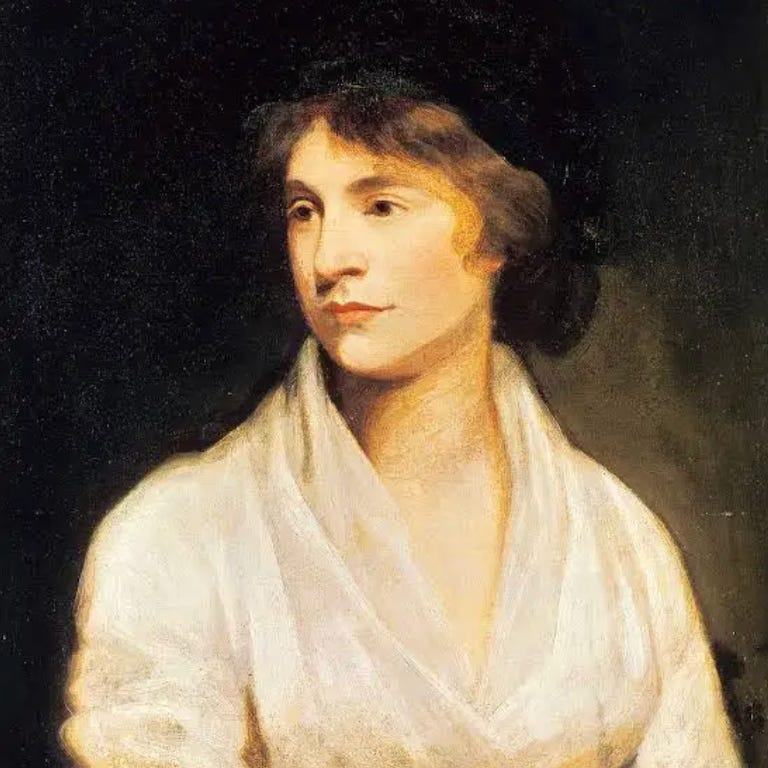
There’s a woman who saw this two hundred and thirty years ago, and she didn’t see it from a safe distance. She lived inside the trap she was describing, badly, publicly, in ways that got her called hysterical by people who hadn’t read a word she wrote. Mary Wollstonecraft didn’t argue that women should feel less. She argued something much more dangerous — that the demand for female calm was never about truth. It was about control, dressed up as concern for your credibility.
I want to walk you through what she actually said, because it’s not the tidy feminist-history-month version. It’s sharper than that. It cuts a specific way, and I think it cuts toward you, this week, in that meeting, in that car park, on that phone call to me.

What “Delicacy” Was Actually Built For
Picture the world Wollstonecraft was writing in. Not medieval, this is 1792, the Enlightenment is in full swing, reason is the coin of the realm, and every serious man in Europe has an opinion about what women are for.
Rousseau had already given the era its answer. In Emile, he laid out an entire educational philosophy for boys built around reason, independence, the cultivation of judgment. Then he got to the chapter on Sophie, the girl, and the register changed completely. Girls should be trained to please. To be modest, soft, a little helpless. Their minds didn’t need strengthening, they needed ornamenting. A woman’s highest achievement was to be agreeable enough that a man would want to spend his reason on her behalf.
This wasn’t a fringe view. It was the mainstream. An entire genre existed to reinforce it, conduct books, sold by the thousand, teaching young women the choreography of acceptable feeling. You could be delicate. You could faint. You could blush, tremble, sigh, weep prettily at a sad novel. What you could not do was be angry about anything real. Anger implied you’d noticed something wrong with the arrangement. And noticing was not a delicate quality.
This was the cult of sensibility, an entire aesthetic built around female emotion, and here’s the part that should stop you: it permitted feeling generously. Women were allowed to feel enormously, publicly, theatrically. Just never about anything that threatened anyone.
Wollstonecraft grew up watching this machine work at close range. Her father was violent and unpredictable. Her mother absorbed it without complaint, because complaint wasn’t available to her, not as a respectable woman, not as someone who needed to keep the household functioning. Wollstonecraft watched her sister Eliza go through a breakdown in a marriage nobody would let her leave, because leaving would have required someone believing her account of her own suffering was reasonable rather than excessive.
By the time she sat down to write A Vindication of the Rights of Woman, she wasn’t building an abstract argument. She was settling a score with a system she’d watched break specific women she loved.
The book most people remember for one line, women should be treated as rational creatures, not decorative ones, and they stop there, as though her point was simply let women think too. That’s the sanitized version. The actual argument goes somewhere much more uncomfortable, and that’s where we’re headed next.
