

It starts to rain, hard, out of nowhere. Everybody on the street does the same thing. Heads go down. Shoulders go up. People walk faster and look only at the ground in front of their feet.
Hiroshige caught that exact moment in 1857.
The Rain
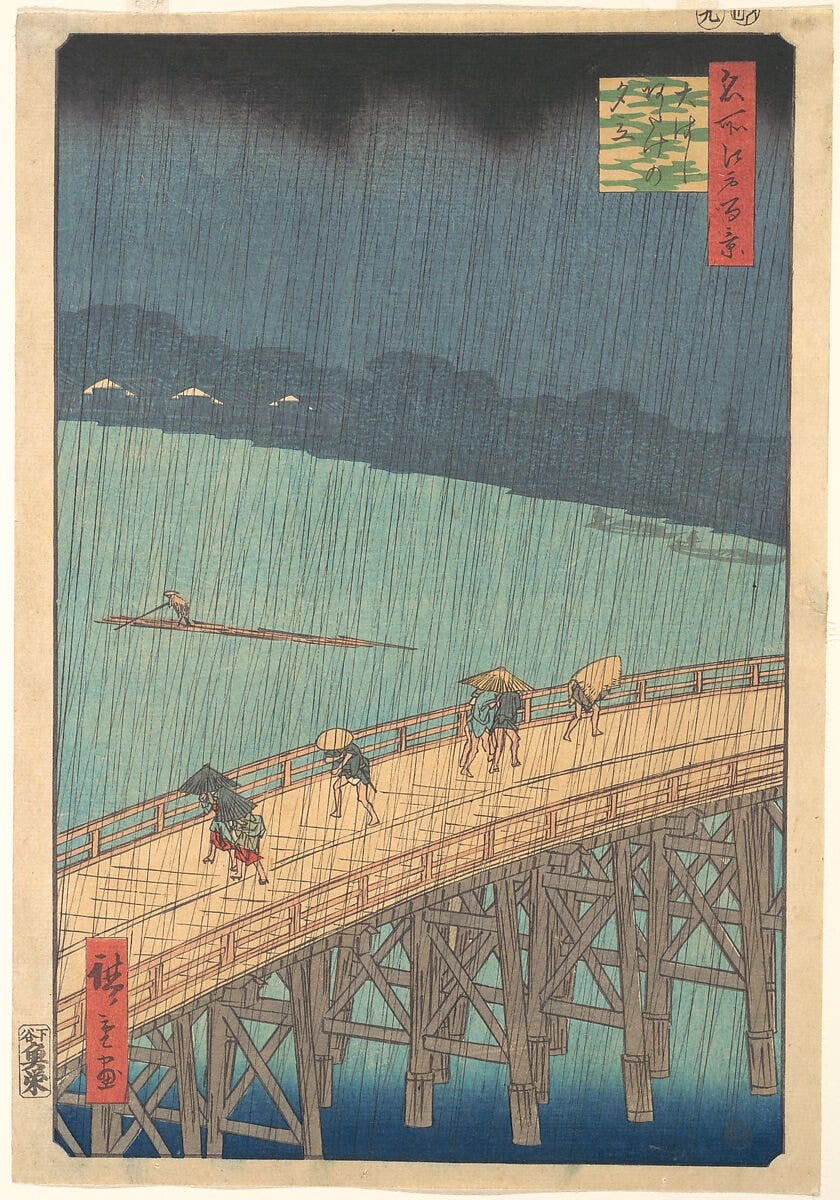
Utagawa Hiroshige was a Japanese artist who made woodblock prints. These are pictures carved into wood and stamped onto paper, so many copies could be sold. This one comes from a series of views of Edo, the old name for Tokyo.
A wooden bridge cuts across the picture. A handful of people hurry over it. Some hold straw mats or hats over their heads. Two share one umbrella. Nobody looks up.
Below them, on the gray river, a man stands on a raft of logs and pushes it along with a pole. He’s alone, out in the open, getting soaked.
Then there’s the rain. Hiroshige drew it as hundreds of thin dark lines set at two slightly different slants, so the storm seems to move. Rain is hard to draw. It’s everywhere, and you mostly don’t see it. You just feel it.
Van Gogh loved this print so much that he copied it in paint in 1887.
Look again at the people on the bridge, though. They feel the rain, and their whole bodies answer it at once. A Chinese thinker from more than three hundred years earlier would have pointed straight at that.
Knowing Is Doing
Wang Yangming lived in China from 1472 to 1529. He was a government official, a general and a teacher.
As a young man, he tried to learn the truth of things by staring at bamboo. He and a friend sat in front of the plants for days. They learned nothing, and both got sick.
Later, sent away to a far corner of the country as punishment, he worked out a different idea. He called it zhi xing he yi, which means “knowing and acting are one.”
His example was simple. When you see a lovely color, you like it in the same moment. You don’t see it first and then decide to like it. When you smell something rotten, you pull back right away.
Real knowing works like that. It moves you.
So he said something that sounds harsh: “There have never been people who know but do not act. Those who are supposed to know but do not act simply do not yet know.”
Most of us carry a list of things we “know” are wrong. The coworker who gets talked over in every meeting. The neighbor nobody checks on. The joke at someone’s expense that everyone laughs at a little.
We know. We walk past anyway.
By Wang’s measure, we only know these things the way we know a fact for a quiz. We haven’t felt the rain yet.

The Evening Check
Some wrongs are loud. Those are the easy ones. The hard ones are the wrongs everyone around you treats as normal. When nobody reacts, your own reaction goes quiet too.
Here’s something to try this week.
Each evening, before bed, ask yourself one question: what did I walk past today?
Skip the big stories in the news. Pick something you saw with your own eyes. A sign in a shop window. The way a manager spoke to a cashier. The friend who went silent in the group chat.
Write it down in one line.
Then ask a second question: what’s the smallest thing I could do about it? Go smaller than you think. A message. A word in the
next meeting. A plain “Are you okay?”
You don’t have to do it yet. Just write it next to the first line.
After a few days, you’ll notice the list gets easier to fill. You start catching these moments while they’re happening, and not only at night.
Then, some ordinary afternoon, you’ll be standing in the middle of one, and you’ll do the small thing without planning to. Your body will answer before you’ve decided.
That’s what the people on Hiroshige’s bridge are doing with the storm.
Now look at the man on the raft again. Somebody up there could have waved him in.
