


The Crooked Tree
A man complains to his friend about a tree.
The man is Huizi, a sharp talker who argues with Zhuangzi all through the old book that carries Zhuangzi’s name. Zhuangzi was a Chinese thinker who lived about 2,300 years ago. His book is full of jokes, talking animals and trees with opinions.
Huizi’s tree is huge. Its trunk is so knotted you can’t mark a straight line on it. Its branches twist too much for a ruler. It stands by the road, and carpenters walk past without a glance.
So it’s useless, Huizi says. Just like your big ideas.
Zhuangzi doesn’t get defensive. He tells Huizi to plant the tree somewhere wide and empty, then wander around it and nap in its shade. No axe will ever cut it down, he says, because nobody wants it.
Three chapters later, a tree gets to answer for itself.
Carpenter Shi
A carpenter named Shi passes a giant oak by a village shrine. It’s big enough to shade thousands of oxen. Crowds come to stare. Shi’s young helper stares too, then runs to catch up with his boss.
Shi doesn’t even slow down. Worthless wood, he says. Make a boat from it and the boat sinks. Make a coffin and it rots. That’s why it has lived so long.
That night the oak turns up in his dream, and it’s annoyed.
Look at the fruit trees, it says. Once their fruit is ripe, people pull at them and snap their branches. Their gifts make their lives bitter. The oak says it has worked for years at being of no use, and that this is its great use.
Most of us were raised on the fruit tree’s plan. Be handy. Be the straight plank. Learn the skill people pay for, then do it fast and clean.
That plan worked for a long time. Now plenty of people watch a machine write the email, sum up the report and build the chart, and they can hear the axe.
Straight wood is exactly what a machine cuts best.

The Waterfall
Around the year 1200, a court painter named Ma Yuan, or someone close to his style, painted a small picture on silk. It’s an album leaf, which means a single page made for a book of pictures. The Metropolitan Museum of Art in New York owns it, and you can look at it free online.
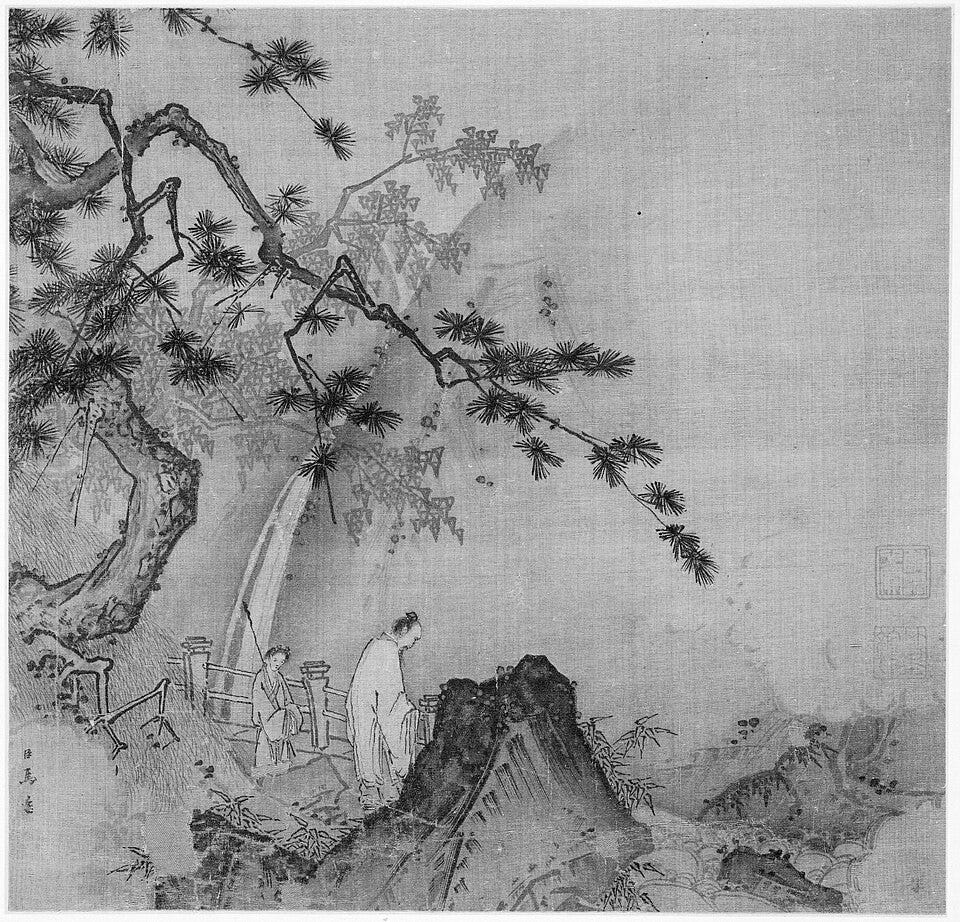
A scholar sits on a rock near a twisted pine and looks toward falling water. Much of the silk is mist and blank space. Ma Yuan was famous for pushing the action into one corner.
The scholar isn’t making anything. Nobody could send a bill for what he’s doing.
Yet someone at the court thought this kind of looking deserved a painting.
So here’s a plain question to put to your own work. Take one task at a time and ask: could a stranger check this without knowing me?
If the answer is yes, the wood is straight. Someone can write down what “done right” looks like, and anything that can be written down that clearly is something a machine can learn. Keep doing it, sure. Just stop resting your rent on it.
If the answer is no, you’re near something a machine can’t want. A client calls you because you noticed last year that she was scared. Your team trusts your call when the numbers disagree. You stay with a messy problem until it changes shape. None of that fits a ruler.
Try it this week on one ordinary workday. Make two columns on a scrap of paper. Put each task in one of them, and be honest, because most of us file our proudest work under the wrong heading.
Then look hard at the short column. That’s where you’ll want to spend more of next year.
