


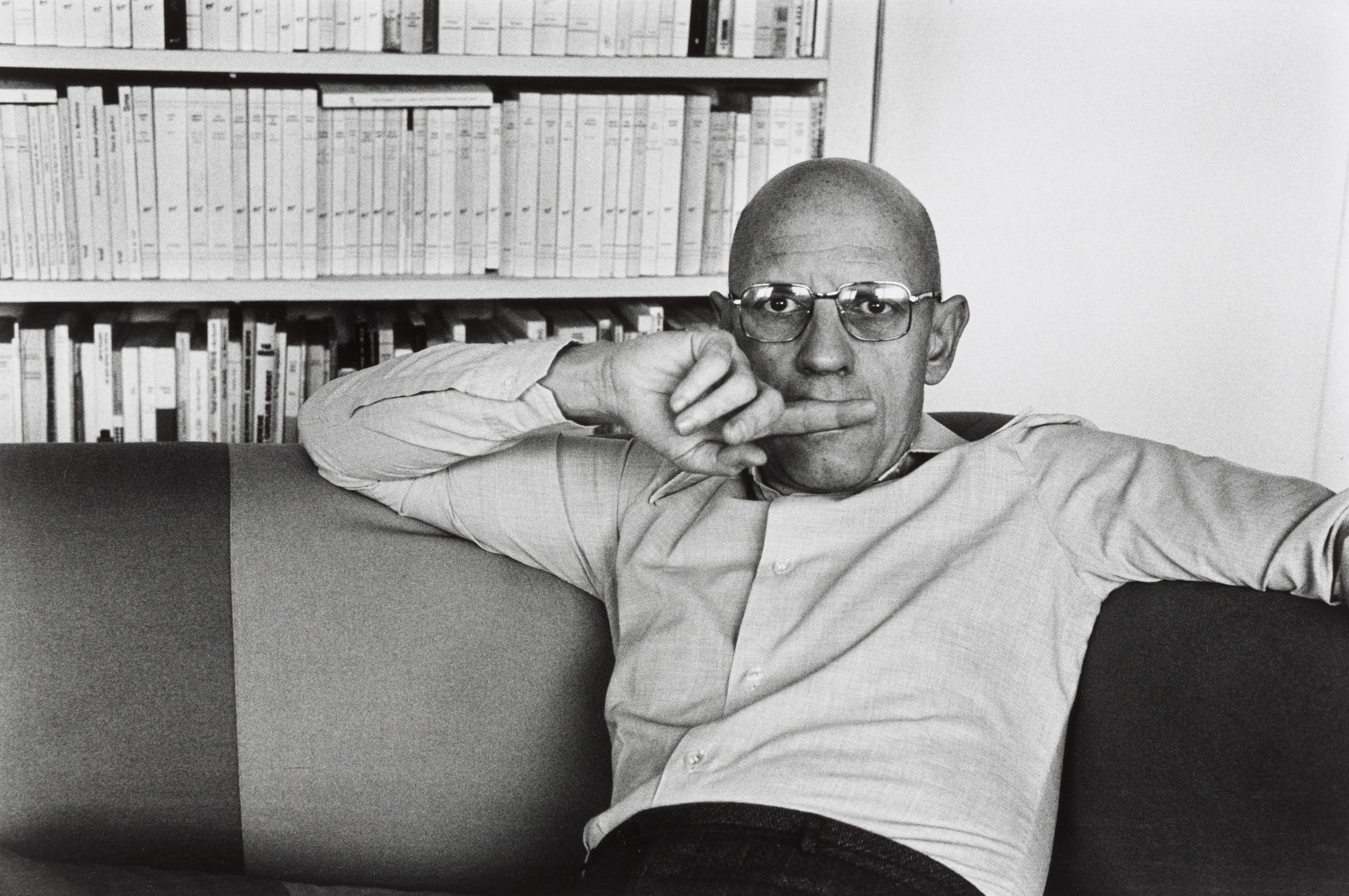
Imagine, for a moment, that your mind isn’t entirely your own. Not in a sci-fi, mind-control chip kind of way, but in a far more insidious, subtle sense. What if the very categories you use to understand yourself – your identity, your desires, your “normalcy” – were less about inherent truth and more about carefully constructed systems of control? This isn’t a paranoid fantasy; it’s the unsettling yet profoundly insightful world illuminated by Michel Foucault, a philosopher who dared to peel back the layers of our social reality to expose the intricate dance between power and knowledge.
We often think of power as something wielded by kings or governments, something that restricts us with laws and prisons. We think of knowledge as neutral, objective truth, discovered by wise men and passed down through generations. Foucault challenged both these comforting assumptions, revealing them as two sides of the same coin, constantly shaping and reinforcing each other in ways we rarely perceive.
The Birth of Knowledge, The Hand of Power
What makes something “true”? Is it simply what we’ve always believed? Foucault argued that knowledge is never innocent. It doesn’t just describe reality; it actively constructs it. Think about the history of medicine. Not long ago, “madness” was seen as demonic possession. Then, it became a treatable illness. Each shift wasn’t just a scientific discovery; it was a redefinition of who could speak, who could judge, and who could control the “mad.”
This is where Foucault’s “critique of norms” comes into play. What we consider “normal” – in sexuality, mental health, criminality – isn’t a natural state. These norms are products of specific historical periods and the power structures that define them. They are frameworks, often invisible, that tell us how to think, how to behave, and even how to desire.
There is no power relation without the correlative constitution of a field of knowledge, nor any knowledge that does not presuppose and constitute at the same time power relations.
— Michel Foucault
Power’s Capillary Reach: Beyond the Throne
Forget the image of power flowing from a single, omnipotent ruler. Foucault showed us a more diffuse, “capillary” power. It flows through every vein of society, operating not just through prohibition but through production – producing subjects, producing truths, producing “normalcy.”
Consider our “social control institutions”:
Prisons: Not just for punishment, but for categorizing, monitoring, and attempting to reform “delinquents.”
Schools: Shaping young minds, instilling disciplines, and defining what counts as legitimate knowledge.
Hospitals and Asylums: Diagnosing, treating, and normalizing bodies and minds, often creating the very categories of illness they claim to cure.
Factories: Organizing bodies in space and time, fostering efficiency and obedience.
These institutions aren’t just places where power is exercised; they are sites where knowledge is generated about human behavior, and where that knowledge, in turn, allows for greater control. They are the silent architects of our social order, subtly guiding us into predefined roles and understandings of ourselves.
The Illusion of Freedom and the Struggle for Agency
If power and knowledge are so intertwined, if norms are so deeply embedded, where does that leave “individual agency”? Are we merely puppets dancing to invisible strings? Foucault didn’t deny the possibility of resistance, but he saw it as a complex, ongoing struggle. We are not simply coerced from the outside; we are often complicit, internalizing the gaze of power, becoming our own wardens.
The path to agency isn’t about escaping power entirely – that’s impossible. It’s about understanding how power operates, questioning the norms that define us, and exposing the knowledge regimes that shape our reality. It’s about refusing to be passively categorized and attempting to re-write the rules of the game.
Power is everywhere, not because it embraces everything, but because it comes from everywhere.
— Michel Foucault
The deepest battle for freedom might not be against visible tyrants, but against the invisible architectures of thought that define what we can be.
Unlock deeper insights with a 10% discount on the annual plan.
Support thoughtful analysis and join a growing community of readers committed to understanding the world through philosophy and reason.
Awakening to the Architecture of Our Minds
Foucault’s insights are not meant to breed despair but to ignite a critical awareness. By understanding how power and knowledge construct our realities, we gain the tools to question them. We begin to see the invisible threads that weave through our institutions, our language, and even our most intimate sense of self.
It’s a call to scrutinize the taken-for-granted, to challenge the “natural,” and to recognize that what we consider objective truth often serves specific interests. In a world saturated with information and competing narratives, Foucault reminds us that critical thinking isn’t just about discerning facts; it’s about dissecting the very frameworks through which those “facts” become meaningful, empowering us to become more conscious participants in the ongoing creation of our shared reality.
Ready for Deeper, Uncensored Philosophy?
If you enjoy Philosopheasy, you might love PhiloCrux — my private higher-tier platform.
Weekly in-depth video masterclasses, deep-dive analyses, and premium resources in a completely uncensored, ad-free vault.
A separate, deeper tier for those who want more intensity and uncensored exploration
Interesting. Thank you.
I've had a man trying to tell me that empathy is innate, not influenced, taught or otherwise learned.
He said that causing an animal to suffer and die, personally, for pleasure was horrendous. But, paying someone else to do it, out of sight, still for one's convenience, profit and/or pleasure, was "fine"; empathetically and ethically acceptable. That the experience of the animal, is the same ... wasn't "the point".
I despair.
They can't have power over you if you question everything. Now I understand why people in power get pissed off when I question their ideas. I'm not being critical. Usually I'm just trying to understand their logic before I can formulate a response. Questioning before accepting is a lost practice. Unfortunately, I taught my children to question everything and they no longer believe a thing I say.