


We live our lives governed by an unspoken assumption: that the world is a zero-sum game of scarcity and competition. But what if this foundational belief is not a law of nature, but a failure of imagination? Decades ago, the visionary architect and inventor Buckminster Fuller offered a radical prophecy—a blueprint for a world where technology and systemic thinking could unlock a sustainable, equitable existence for every person on the planet. He argued that Earth possesses more than enough resources for all, and that our crises of poverty and conflict are not inevitable, but are, in fact, design flaws. This is the story of that forgotten prophecy, a call to action more urgent today than ever before.
Background of a Visionary
R. Buckminster Fuller, born in 1895, was an American architect, inventor, and philosopher whose innovative contributions and visionary ideas have significantly influenced modern design and sustainability practices. Known for inventing the geodesic dome, Fuller advocated for a more efficient use of resources and sought to improve living conditions globally, long before such concepts gained traction in mainstream discourse.
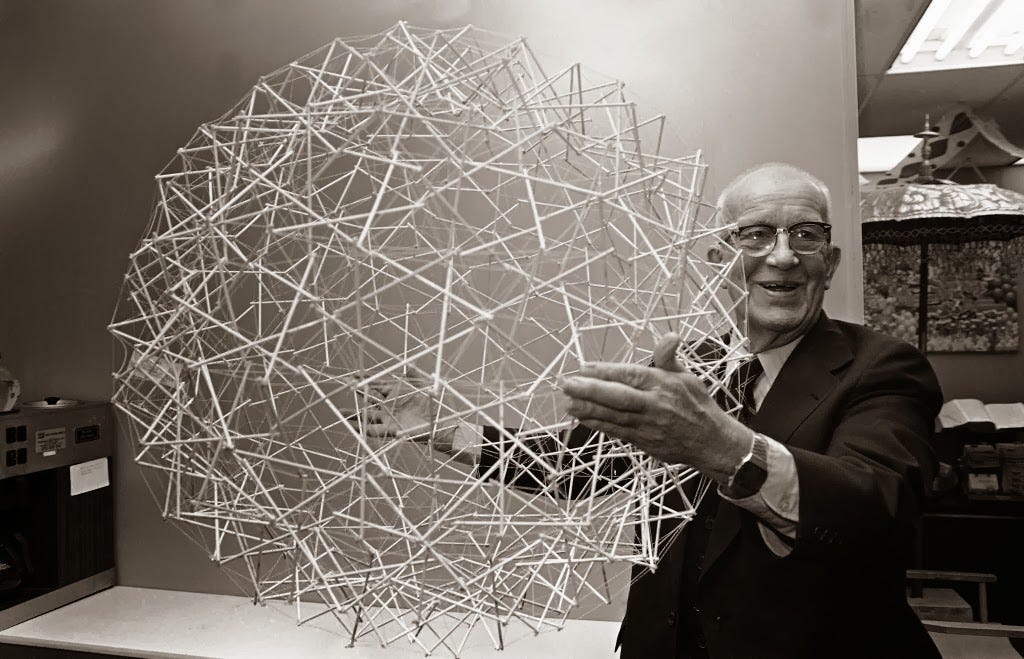
Fuller’s early life was marked by challenges, including poor eyesight and struggles within the traditional education system. He was able to overcome these hurdles, demonstrating a remarkable creativity that began in childhood, where he famously created a tetrahedronal octet truss from toothpicks and dried peas at the age of six. Despite flunking out of Harvard University twice and navigating a tumultuous path that included serving in the Navy and working as a meatpacker, Fuller eventually emerged as a prominent figure in engineering and design.
Throughout his life, Fuller emphasized the importance of education and experience in personal development. He believed that enhancing an individual’s experience inventory could lead to greater understanding and application of universal principles in design and living. His lectures, such as the twelve-part series “Everything I Know,” encompassed a broad range of subjects, including architecture, design, philosophy, and economics, showcasing his interdisciplinary approach to education and invention.
Fuller’s philosophy extended into his concept of “ephemeralization,” which refers to the ability to do more with less—an idea that aligns with his vision of achieving worldwide abundance through improved design. His life and work continue to resonate, as evidenced by recent exhibitions and challenges that celebrate his legacy and relevance in contemporary discussions surrounding sustainability and innovative design.
The Prophecy of Abundance
Buckminster Fuller articulated a vision known as the “prophecy of abundance,” which posits that through the application of innovative technologies and systemic thinking, humanity can achieve a sustainable and equitable existence for all. He believed that the resources available on Earth, when used efficiently, could meet the needs of 100% of humanity while preserving the planet’s ecological balance.
Foundations of the Prophecy
Fuller’s concepts emerged from a synthesis of various philosophical ideas and practical insights gathered over his lifetime. He frequently emphasized the importance of cooperation among nations and communities to realize a world that works for everyone. His advocacy for “spontaneous cooperation” was a cornerstone of his vision, suggesting that collective efforts could eliminate ecological harm and social disadvantages.
The political problem of mankind is to combine three things: economic efficiency, social justice, and individual liberty.
John Maynard Keynes
Technological and Social Implications
Fuller foresaw a future where advanced technologies would transform society, redirecting resources from destructive to constructive purposes—what he referred to as “livingry” instead of “weaponry”. He argued for a
