


You are scrolling past another post you disagree with, and without quite deciding to, you pause. Your pulse ticks up. Some part of you wants the friction. You’re not proud of it, but the possibility of a real argument — the bright, clarifying heat of it — feels almost physical. And then, just as quickly, you scroll on. Not because you’ve found peace. Because you’ve remembered you’re supposed to be above this. You close the app and feel a quiet, curious loss, as if you’d reached for something solid and pulled back an open hand.
The moment stays with you not because it’s rare, but because it’s ordinary to the point of invisibility. We live inside a tension we rarely name: a society that preaches calm feels, to many, half-asleep, and the impulse to draw a line between “us” and “them” doesn’t only come from anger — it comes from a hunger for shape. That’s where this week’s arc began, and it hasn’t let go of me yet.
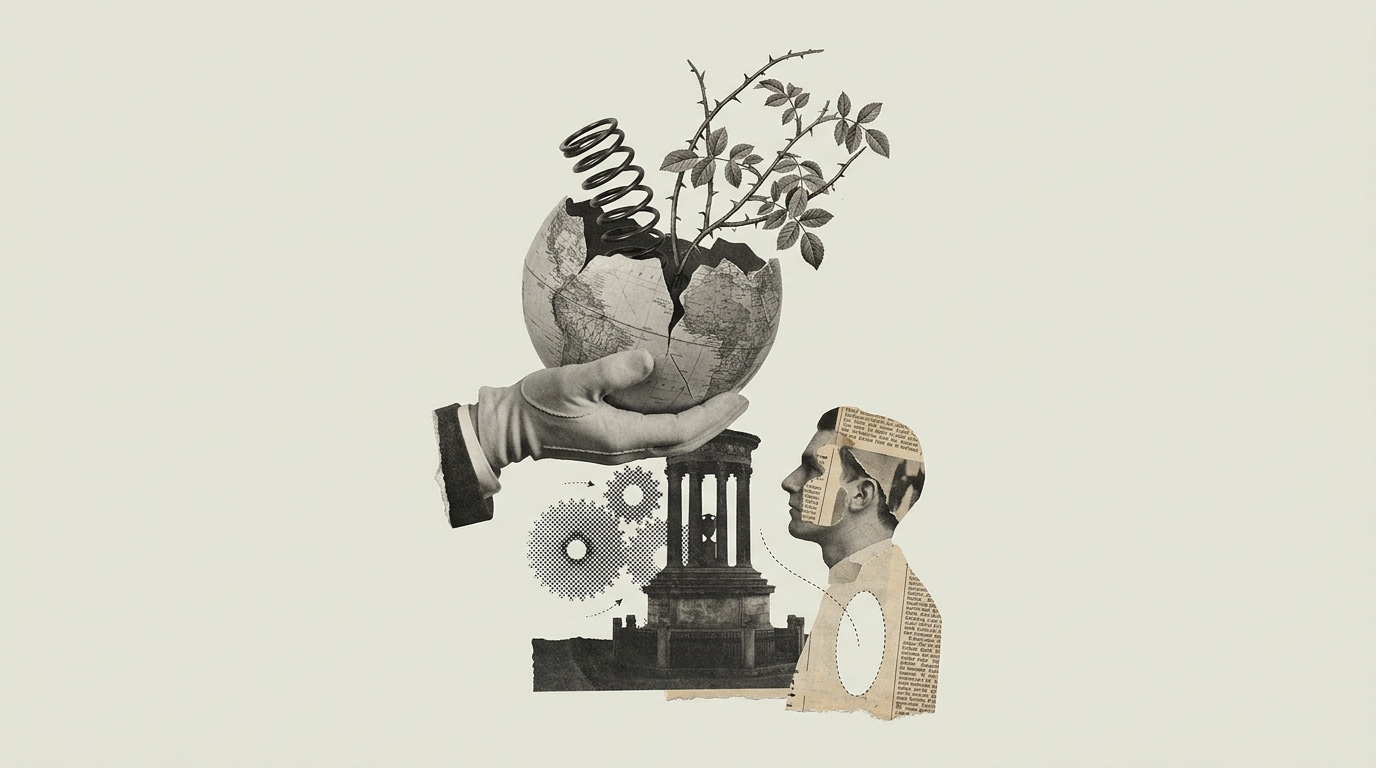
The question living inside the week
The whole thing kept circling one uneasy knot. On Monday, with Carl Schmitt, we looked straight at the idea that political identity doesn’t emerge from reason — it emerges from the act of naming an enemy. Not out of cruelty, but out of necessity: without a them, Schmitt argued, there is no coherent us. The thought is uncomfortable because it sounds archaic, yet it explains a great deal about why even the most trivial online dispute can feel existentially charged.
But if that’s true, then we’re left holding a question that doesn’t fit neatly into the vocabulary of modern well-being: If we need an enemy to feel whole, what do we do with that need in a life that genuinely wants to be good? Do we suppress it? Redirect it? Deny it altogether — and if so, where does the hunger go?
That single question was the spine of everything that followed, and it’s still open.
Two doors left ajar
On Wednesday we walked into a darker corridor. Ernst Jünger saw something in the storm of steel that peace could never replicate: a clarity so total it made ordinary existence feel like an anesthetic. The deep dive didn’t offer a tidy moral. Instead, it pressed a more uncomfortable inquiry: What does it mean if the most alive some people ever feel is when the world is breaking apart — and what does that reveal about the emptiness they’re fleeing? Once you start asking that, “polarization” stops looking like a glitch in the system and starts looking like a symptom of something far more personal.
Friday’s episode came at the problem from the opposite direction — not from the battlefield but from the stairs and sidewalks of daily life. Michel de Certeau proposed a form of resistance so quiet most of us miss it. The episode begins with a claim that sounds wrong until it doesn’t: that the most consequential refusal isn’t the one you announce, but the one you are. A way of walking, of naming, of making-do that rewrites the rules without ever confronting them head-on. The question it answers — Why do our smallest, most invisible acts of refusal matter at all? — turns out to be the kind of thing that rearranges how you see a morning commute. But exactly how it connects to the hunger for enemies is the live wire we left uncovered.

A step further into the knot
Here’s where I’ve landed, at least for tonight. The impulse Schmitt described and the allure Jünger captured aren’t character flaws to be scrubbed away. They are native to the human mind’s need for form — for an edge that tells you where you stop and the world begins. The trouble isn’t the need; it’s that we’ve forgotten how to meet it without destruction. De Certeau’s genius, I think, is that he found a way to meet it sideways: carving out meaning not by vanquishing an enemy but by quietly refusing to accept a world that would turn you into a passenger in your own life. A small, stubborn gesture can be a line drawn, a “this is me” that costs no blood.
And yet. A quiet refusal is not a fight. It may give shape to a day, but does it give shape to a soul in quite the way an adversary does? That’s the question I can’t stop turning over. If we still carry a Jüngerian ache — a longing to feel real by standing against something — can a politics of small, invisible refusals ever be enough? Or does the hunger simply go looking for a louder meal elsewhere?
I don’t have a tidy ending because the arc isn’t finished. That’s the point. The moment at the screen — the unfinished reach for a fight — is a map to something. Sunday is for holding the map up to the light, not for telling you where the road goes.
Members get the Wednesday deep dive, the Friday episode, and the full archive — and over a few weeks, a working set of tools for thinking clearly about conflict, belonging, and what makes a life feel like it matters.