


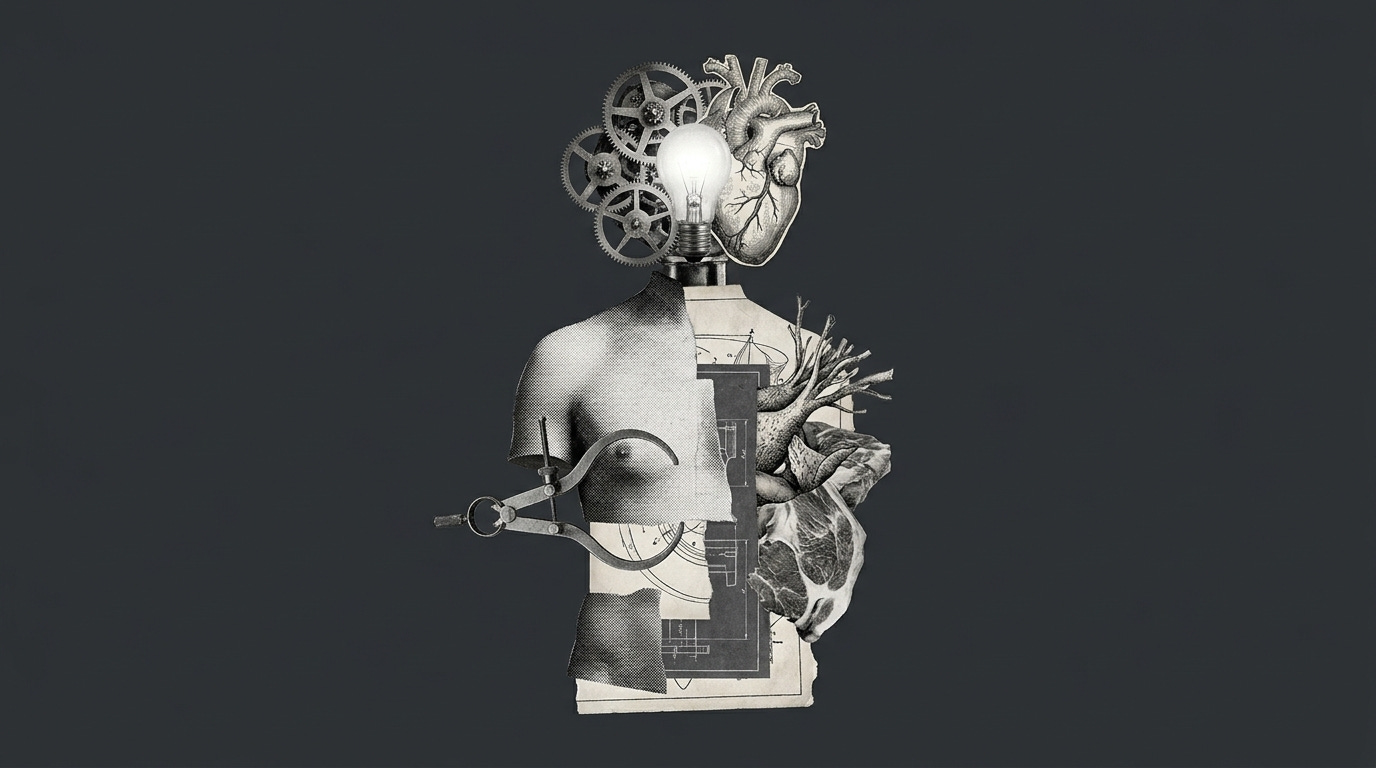
The modern obsession with bodily optimization is not about health, but a profound alienation from our own messy, unpredictable biology. We are living through a golden age of biological management. We track our sleep cycles, measure our heart rate variability, monitor our blood glucose, and ingest carefully calibrated stacks of supplements to manipulate our neurochemistry. On the surface, this looks like a culture deeply invested in physical vitality.
But look closer, and a different psychological reality emerges.
This hyper-fixation on optimization is not a celebration of the body. It is an evasion of it. We have come to view our own physical form as a problem to be solved, a machine to be tuned, or, more accurately, a piece of faulty legacy hardware that we are desperately trying to patch. We are terrified of our own meat.
In a world defined by frictionless digital interfaces and instant algorithmic predictability, the human body remains stubbornly analog. It aches. It ages. It requires rest. It operates on rhythms that do not care about our productivity goals or our calendar invites.
We do not track our biometrics to understand our bodies, but to distance ourselves from them—translating flesh into the safer, more controllable language of data.
This friction between the demands of modern life and the reality of human biology has produced a new kind of psychological dissonance. We no longer inhabit our bodies; we manage them from a distance. We have become alienated from the very vessels that keep us alive, experiencing our own biology not as a home, but as an uncanny, unpredictable threat.
The Body as an Enterprise
To understand how we arrived at this state of biological alienation, we can look to the late cultural theorist Mark Fisher.
In his landmark work on Capitalist Realism, Fisher argued that late modern capitalism forces us to internalize systemic demands to such a degree that we begin to view ourselves as individual corporations. Every aspect of our existence—our education, our social networks, our mental health—becomes an asset to be managed, leveraged, and optimized for maximum output.
Fisher noted that this economic logic inevitably colonizes our internal lives. When we are exhausted, anxious, or burned out by the relentless pace of the modern world, we do not blame the world; we blame our own biology. We treat our exhaustion as a personal failure of optimization rather than a natural response to an unnatural environment.
When we apply Fisher’s framework to the modern biohacking movement, the deeper twist becomes visible. We are not optimizing our bodies to feel more alive. We are optimizing them to meet the demands of a system that views biological limits as a liability.
The body becomes an external object. It is no longer “me”; it is “it.”
This creates what Fisher, in his aesthetic theory, might call a sense of the weird—the unsettling presence of something that does not belong. In our hyper-managed, digitized lives, the wet, messy, decaying reality of our own flesh feels like an alien intrusion. It is the one thing we cannot fully domesticate.
The Uncanny Valley of Optimization
When you treat your body as a machine to be hacked, you inevitably adopt the mindset of a mechanic—or a hacker. And the language of “hacking” implies an adversary.
We speak of “tricking” our metabolism, “bypassing” our fatigue, and “overriding” our natural impulses. This is the rhetoric of warfare. We are engaged in a low-level insurgency against our own biology, attempting to force it into a state of permanent, frictionless productivity.
To “hack” your biology is to declare war on your own nature, treating the vessel that keeps you alive as a stubborn piece of legacy software.
This adversarial relationship breeds the biological uncanny. The uncanny, in a psychological sense, is the feeling of encountering something that is simultaneously familiar and deeply alien. When we look at our bodies through the lens of continuous optimization, we experience this exact sensation.
We look at our hands, our stomachs, our tired eyes, and we do not see ourselves. We see a dashboard of metrics. We see a system that is currently underperforming. We become ghosts haunting our own machines, entirely severed from the somatic, intuitive experience of being alive.
The tragedy of this alienation is that the more we try to control the body, the more foreign it feels. Total optimization requires total surveillance, and total surveillance requires us to constantly step outside of ourselves to monitor the data. We lose the ability to simply be physical creatures.
Outsourcing the Senses
Nowhere is this dynamic more concrete than in the explosion of wearable health technology.
Consider the modern morning routine of the optimized knowledge worker. Before they even stretch, before they take a breath and register how their muscles feel or what their energy level is, they reach for their phone to check the data from their sleep ring.
They outsource their own physical sensation to an algorithm. If the screen says their recovery score is low, they feel tired. If the screen says their sleep was optimal, they feel energized.
The ultimate modern fantasy is not immortality, but total frictionless predictability; we are terrified of the body because it is the one thing that still refuses to comply.
This is a profound abdication of somatic intuition. We no longer trust our own nervous systems to tell us how we feel. We require an external, digital authority to validate our biological reality.
This behavior is not driven by health; it is driven by anxiety. It is the anxiety of being trapped in a biological form that operates outside of our conscious control. The wearable device acts as a psychological buffer, a way to translate the terrifying, unpredictable messiness of the flesh into clean, manageable, mathematical certainty.
But the certainty is an illusion. The body is not a spreadsheet. It is a highly complex, deeply integrated ecology that responds to grief, joy, weather, connection, and meaning in ways that no algorithm will ever fully capture.
Reclaiming the Meat
The modern obsession with optimization promises mastery over the body, but it delivers only estrangement. By treating our biology as an external project to be managed, we exile ourselves from the only home we will ever know.
The alternative is not to abandon health, but to abandon the illusion of total control.
To escape the biological uncanny, we must stop viewing the body’s limitations—its need for rest, its fluctuations in energy, its slow and inevitable aging—as bugs in the system. These are not failures of optimization. They are the defining features of being a living creature.
Real vitality does not come from hacking the machine until it complies. It comes from the much harder, much braver work of accepting the messy, unpredictable reality of the flesh. We are not software. We are meat, breath, and bone. And it is only when we stop fighting that reality that we can actually begin to inhabit it.

Or save 25% and get 3 months free
We spend our days diagnosing the symptoms of modern alienation, but the real intellectual work lies in systematically dismantling the frameworks that keep us trapped. The full Philosopheasy edition is where we move from pointed cultural critique to comprehensive philosophical structure, giving you the exact conceptual tools to navigate a hyper-quantified world. Join us inside to unlock the complete archive and transform how you understand the mechanics of modern life.
This is a sharp and necessary theme. The hidden horror of the optimized life is that it can make a person more efficient while making him less available to reality. Optimization promises freedom from waste, friction, delay, and disorder. But those are often the very conditions in which the human person is formed: waiting, failing, revising, forgiving, lingering, being interrupted by someone who cannot be turned into a productivity metric. A life can be perfectly organized and still spiritually homeless. The question is not only whether we are using our time well, but whether our time is still capable of becoming presence.
Well their optimising has created morbidly obese, tired , dumbed down , disconnected, individuals.