


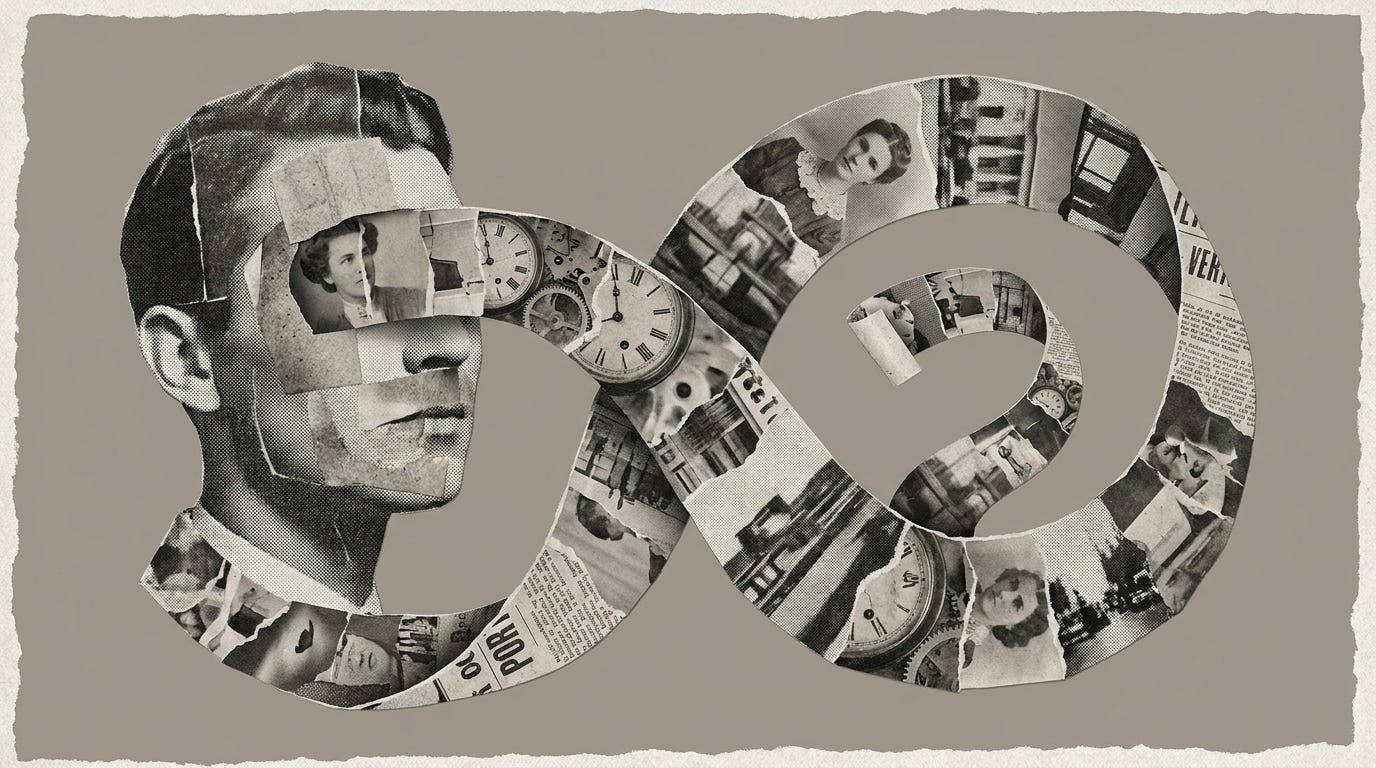
When we critique our relationship with digital media, we almost always rely on the metaphor of theft. We complain about “lost hours” and “wasted time,” treating time as a finite resource that our screens are quietly siphoning away. We download apps to track our usage, impose arbitrary daily limits, and promise ourselves that tomorrow, we will be more disciplined.
But viewing the infinite scroll merely as a mechanism of distraction is a superficial diagnosis. It misses the deeper, structural transformation occurring just beneath the glass.
The digital feed is not simply stealing our time; it is altering what time actually feels like. By stripping away the natural boundaries of beginning, middle, and end, the architecture of modern media has collapsed our distinct perceptions of past, present, and future. We are no longer moving through time. Instead, time is washing over us in a singular, flattened, and inescapable stream.
We treat the infinite scroll as a thief of our time, but its true danger is far more profound: it is the architect of a flattened reality where past, present, and future blur into a single, inescapable “now.”
To understand why this feels so disorienting, we must look past the content on our screens and examine the invisible logic of the medium itself.
The Medium is the Timeline
In 1964, the media theorist Marshall McLuhan famously declared that “the medium is the message.” His central insight was that we are consistently blinded by content. We argue endlessly about what is on the screen—the political outrage, the viral trends, the breaking news—while ignoring how the screen itself is rewiring our senses.
For McLuhan, the “content” of a medium is just the juicy piece of meat carried by the burglar to distract the watchdog of the mind. The true message is the change of scale, pace, or pattern that the medium introduces into human affairs.
Apply this framework to the infinite scroll.

Or save 25% and get 3 months free
The printed book was a medium that imposed a specific temporal logic. It had a physical beginning, a sequence of pages that required linear progression, and a definitive end. It trained the human mind to think in terms of cause and effect, history and resolution. It reinforced the idea that time moves forward.
The infinite feed operates on a radically different logic. There is no first page and no final chapter. There is no pagination to signal progress. The interface is designed to be bottomless. When you pull to refresh, you are not turning a page; you are spinning a slot machine that operates entirely outside of chronological time. The medium’s message is that history and future are irrelevant. There is only the perpetual, algorithmic now.
The Collapse of Temporal Depth
This shift from linear time to a flattened present carries severe psychological implications. Human consciousness relies on temporal depth to make sense of the world. We need a stable past to reflect upon, a grounded present to act within, and a distinct future to anticipate.
When these boundaries collapse, we lose our orientation.
The true crisis of modern attention is not that we are easily distracted, but that our digital tools have abolished the very concept of “later,” trapping us in an artificial, relentless present.
In the physical world, time provides context. A photograph from ten years ago feels distinct from a conversation happening today. But in the digital feed, this context is entirely flattened. The algorithm does not respect chronology; it respects engagement.
As a result, a breaking news alert about a global crisis is wedged immediately between a meme from 2018 and a targeted advertisement for a product you might buy next week. A friend’s resurfaced memory from five years ago sits adjacent to a live broadcast.
Everything is happening all at once. The past is continually recycled as present content, and the future is pre-emptively served to us via predictive algorithms. We are denied the space to reflect on what has happened, and we are robbed of the anticipation of what is to come. We are left suspended in a state of continuous, reactive processing.
The Algorithmic Whiplash
Consider the tangible experience of spending just ten minutes on a platform like X or TikTok.
You open the app and are immediately greeted by a video of a historical event from the 1990s, recontextualized for a modern audience. You scroll. The next post is a highly anxious update about a political election happening next month. You scroll again. You see a deeply personal update from a stranger, followed instantly by a brand trying to sell you a mattress.
Imagine time not as an arrow, but as a digital blender. The feed takes our history, our current anxieties, and our future desires, pureeing them into a thick, disorienting sludge of immediate consumption.
This is not just “context collapse”—the sociological phenomenon where different social circles merge online. This is temporal collapse. The emotional whiplash you feel after a long scrolling session is not merely the result of consuming too much information. It is the physiological exhaustion of your brain trying to process past, present, and future simultaneously, without any of the natural buffers that reality usually provides.
The algorithm organizes the world not by when things happened, but by how intensely they will make you react right now. In doing so, it flattens the rich, three-dimensional landscape of human time into a two-dimensional sheet of endless stimuli.
Reclaiming the Architecture of Time
If the problem were simply a matter of lost hours, the solution would be simple: put the phone in another room. But because the problem is structural—a fundamental shift in how we perceive the flow of reality—the solution requires a more deliberate philosophical intervention.
We cannot resist the flattening of time by merely managing our “screen time.” We must actively rebuild our temporal boundaries. We have to seek out mediums that have endings. We must engage with formats that force us to wait, to remember, and to experience the friction of linear progression.
McLuhan warned us that every new technology amputates a part of our sensory experience even as it extends another. The infinite scroll extended our access to information, but it amputated our natural sense of time. Recognizing this hidden mechanism is the only way to step out of the eternal present and step back into the actual world.
Understanding the hidden architecture of our digital lives is the first step toward reclaiming our agency. In the full edition of Philosopheasy, we move beyond diagnosing these cultural symptoms and build systematic frameworks for navigating them. Join us to unlock the complete archive and access the deeper structural tools required for modern sense-making.

You’ve put words to precisely what I’ve been feeling and thinking about what’s happening to our cognition. The fact that you paired it with an appeal to subscribe both pisses me off and inspires me to pay you again. The tricky part for me about the payment part is that I live on such a small amount of money per month that I have to choose between paying you and paying the light bill on time. What a fucked up world this is because that’s a choice that shouldn’t have to be made.
As someone said a long time ago
“Time is a flat Circle”