


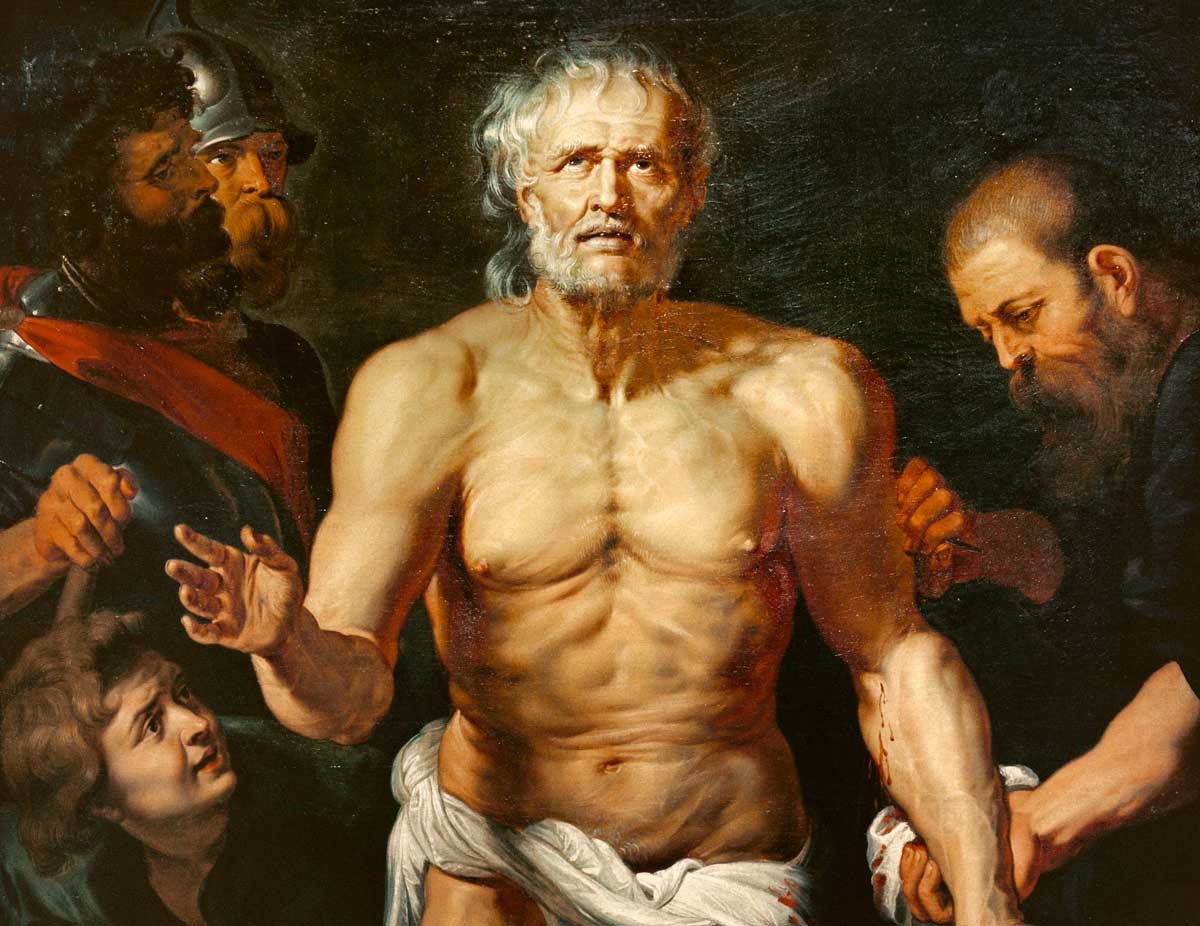
The gentle hum of your phone, the persistent ping of new emails, the relentless scroll of social media feeds – it’s the soundtrack of modern life, isn’t it? We live in a world that demands our attention, fragments our focus, and constantly pulls us into a state of semi-alertness. It’s a perpetual state of readiness for the next digital interruption, a subtle anxiety that gnaws at the edges of our peace.
How do you find serenity in a storm of notifications? How do you maintain your inner equilibrium when the external world seems determined to shake it loose? The answers, surprisingly, might not be found in the latest productivity hack or digital detox fad. Instead, they echo from the ancient streets of Rome, from a philosopher who faced a different kind of chaos, but one equally potent: Seneca.
Seneca, the Roman Stoic, advisor to emperors, and a man who knew both immense power and the sharp sting of exile, understood chaos intimately. His world was one of political intrigue, sudden shifts in fortune, and very real threats to life and limb. Yet, he articulated a profound framework for inner peace, a secret weapon against the turmoil that surrounds us. And here’s the kicker: his timeless Stoic advice works even better in the age of constant alerts, offering a shield against the digital onslaught that threatens to overwhelm our minds.
The Invisible War for Your Mind
Think about it. Every notification is a tiny, almost imperceptible declaration of war on your focus. Every headline screams for your outrage, your concern, your immediate reaction. This isn’t just external noise; it’s an invisible battle for your mind, waged not with swords and shields, but with algorithms and dopamine hits.
Seneca knew that the true battlefield wasn’t the Roman Forum or the imperial court, but the mind itself. He understood that while we can’t always control the external events that buffet us, we absolutely control our response to them. This isn’t passive acceptance; it’s active discernment. It’s the critical difference between being swept away by the tide and standing firm against it.
In our hyper-connected world, this distinction is paramount. The modern age doesn’t just present challenges; it presents them with a velocity and volume that can feel insurmountable. But Seneca offers a way to not just survive, but to thrive amidst this relentless assault on our attention.
The Unshakable Core: Distinguishing Control
At the heart of Seneca’s philosophy is the “Dichotomy of Control.” It’s a deceptively simple, yet monumentally powerful concept: some things are within our control, and some are not. Our actions, our judgments, our reactions – these are ours. The weather, other people’s opinions, market fluctuations, or the latest viral outrage – these are beyond our dominion.
In Seneca’s day, this meant accepting political reversals or the whims of a tyrannical emperor. Today, it means acknowledging that we cannot stop every news alert from popping up, every email from landing in our inbox, or every social media trend from dominating public discourse. But what we absolutely can control is our response to these external pressures. Do we immediately react? Do we let them hijack our emotions? Or do we pause, reflect, and choose our path?
We suffer more often in imagination than in reality.
— Seneca
This insight is a superpower. By consciously redirecting our energy away from what we can’t change and towards what we can, we reclaim agency. We stop being reactive puppets of external stimuli and become deliberate architects of our internal state. This is especially potent in an era where the illusion of control (through constant information) often leads to real anxiety (through lack of actual control).
The Practice of Premeditation: Rehearsing Serenity
One of Seneca’s most radical yet practical tools for staying calm was “premeditatio malorum,” or the premeditation of evils. It sounds grim, doesn’t it? But it’s not about dwelling on negativity. It’s about mentally rehearsing potential difficulties, envisioning worst-case scenarios, not to induce fear, but to inoculate ourselves against it.
Consider the modern anxieties: “What if my internet goes down before my deadline?” “What if I miss an urgent message?” “What if the news gets worse?” Seneca would encourage us to sit with these “what ifs” and mentally prepare for them. If the internet goes down, what’s my backup plan? If I miss a message, is it truly the end of the world, or can it be addressed later?
This exercise disarms the shock of the unexpected. When we’ve already considered a difficulty, its arrival isn’t a destabilizing blow, but a foreseen event, for which we’ve already prepared our mental and emotional defenses. It’s a way of building resilience before the crisis hits, fortifying our minds against the future’s inevitable bumps and jolts.
The Virtue of Stillness: Cultivating Inner Silence
In a world of constant connection, true stillness feels like a luxury, or even a forgotten art. Seneca, however, championed solitude and reflection as essential for inner peace. He understood that ceaseless external stimulation, even in his less technologically advanced time, eroded the capacity for self-awareness and thoughtful deliberation.
To be everywhere is to be nowhere.
— Seneca
This ancient maxim rings truer than ever. When we are constantly jumping from one alert to another, one social media feed to the next, we are indeed “everywhere” and “nowhere” – our attention fractured, our focus diluted. Seneca would urge us to intentionally create spaces of mental quiet, moments where we disconnect from the external deluge and reconnect with our inner selves.
This isn’t just about digital detox; it’s about cultivating an inner silence where our thoughts can settle, where we can process emotions without immediate external input, and where we can remember what truly matters. It’s where genuine calmness is forged, not in the absence of chaos, but in the deliberate mastery of our internal landscape.
To find your calm, you must understand that the external world will always be chaotic, but your internal response is entirely your own to command.
Unlock deeper insights with a 10% discount on the annual plan.
Support thoughtful analysis and join a growing community of readers committed to understanding the world through philosophy and reason.
Conclusion
Seneca’s wisdom is not a quaint historical artifact; it is a live, breathing philosophy perfectly suited for our frenetic age. His secret to staying calm in chaos isn’t about avoiding the storm, but about becoming unshakeable within it. It’s about recognizing the invisible war for your mind and arming yourself with the ancient tools of discernment, premeditation, and stillness.
We cannot control the constant alerts, the breaking news, or the demands of the digital world. But we can control how we respond to them. We can choose to engage thoughtfully rather than react impulsively. We can practice mental resilience and cultivate inner peace. In doing so, we don’t just survive the chaos; we rise above it, finding a profound and enduring calm that no external force can disturb.
Ready for Deeper, Uncensored Philosophy?
If you enjoy Philosopheasy, you might love PhiloCrux — our private higher-tier platform.
Get weekly in-depth video masterclasses, deep-dive analyses, comprehensive study guides, and full access to The Vault: a private archive of 500+ deep-dive explorations. — all in a completely uncensored platform.
A separate, deeper tier for those who want more intensity and uncensored exploration