


There’s a quiet surrender happening all around us, often cloaked in the comforting language of self-care and emotional acceptance. You see it in the hushed tones of sympathetic conversations, the gentle pats on the back, the ubiquitous advice to “feel your feelings.” Someone expresses sadness, and the immediate, almost reflexive response is validation: “It’s okay to feel sad.” But what if it isn’t? What if this prevalent, almost sacred understanding of sadness is not just incomplete, but fundamentally misleading, even dangerous?
Imagine a warrior, standing on a battlefield. He falls, wounded, and his comrades gather around, murmuring, “It’s okay to bleed. You’re allowed to be hurt.” While true on a superficial level, this empathy, if it ends there, is an abdication of duty. It prioritizes feeling over fighting, introspection over action. Sadness, too, often demands this kind of passive acceptance, inviting us to languish in its depths rather than climb out. But what if sadness is not merely a consequence, but a choice? What if, deeper still, it is a moral failing?
The Conventional Lie: Sadness as a Given
Our modern lexicon treats sadness as an unfortunate, yet inevitable, part of the human experience. It’s a “mood,” a “phase,” a “chemical imbalance” perhaps, something that washes over us like bad weather. We are taught to “process” it, to “sit with it,” to “express” it. The prevailing narrative suggests that sadness is a passive state, an external force acting upon us, and our only duty is to react appropriately to its presence.
But does this narrative empower us, or does it subtly disarm us? By framing sadness as an uncontrollable phenomenon, we are excused from examining its deeper origins within our own agency. We become victims to our own internal landscape, rather than its architects. Is it truly a universal, passive experience, or a symptom of something we ourselves permit, even cultivate?
Spinoza’s Radical Truth: Power and Joy as Ethical Imperatives
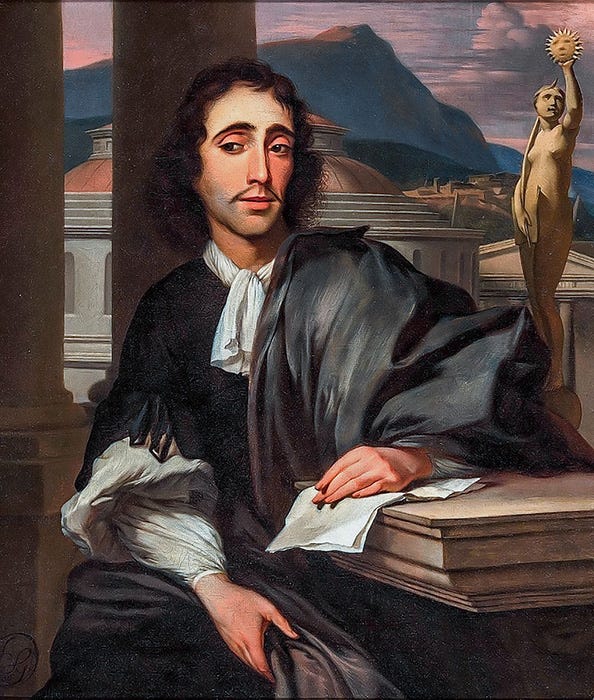
Centuries ago, Baruch Spinoza offered a perspective that starkly contradicts our contemporary understanding. For Spinoza, emotions are not just fleeting feelings; they are intimately tied to our power to act, to our very being. He argued that sadness is not merely an unpleasant sensation, but a literal “decrease in your power to act.” Think about that for a moment. Sadness isn’t just a state of mind; it is a diminishment of your vital force, your capacity to engage with the world, to create, to connect.
If sadness diminishes your power, then its opposite, joy, increases it. This isn’t about superficial happiness; it’s about an expansion of your capabilities, an amplification of your life force. Therefore, for Spinoza, the pursuit of joy becomes a rigorous ethical duty, not a luxurious indulgence. It is a moral imperative to cultivate that which expands your power, and to shun that which reduces it.
Sadness is the passage from a greater to a lesser perfection.
— Baruch Spinoza, “Ethics”
To passively accept sadness, then, is to willingly consent to a reduction of your own ethical efficacy. It is to surrender your potential, to retreat from the full scope of your human duty.
The Architecture of Failure: How We Cultivate Our Own Sorrow
If sadness is a decrease in our power, how do we, often unknowingly, construct the very conditions for its arrival? We are not merely passive recipients of our emotional states; we are active participants in their construction. Consider these common architects of diminished power:
Inaction and Procrastination: The avoidance of duties, the deferral of necessary tasks, the endless loop of “I’ll do it tomorrow” breeds a quiet despair. It erodes our sense of competence and purpose.
Passive Consumption: Endless scrolling, mindless entertainment, the passive intake of negativity from news cycles – these do not energize; they drain. They create an illusion of engagement while siphoning off our vital energy.
Dwelling on the Uncontrollable: Fixating on external circumstances beyond our sphere of influence, rather than focusing on our internal response and actions, is a direct route to powerlessness.
Neglect of Discipline: The absence of structure, routine, and self-mastery in daily life leaves us adrift, susceptible to every passing emotional current.
Failure to Engage with Purpose: When we lack a clear sense of what we are striving for, a meaningful contribution, or a compelling personal mission, we become susceptible to the void that sadness eagerly fills.
These aren’t merely “bad habits”; they are ethical choices that diminish our capacity for a full, powerful life. Are we truly victims of our feelings, or architects of our emotional decline?
The Ascent to Joy: A Discipline, Not a Disposition
If sadness is a moral failure—a failure to maintain and expand our power—then joy is a moral achievement. It is not something that passively befalls us, but something actively cultivated through rigorous discipline and deliberate choices. The ascent to joy is not a path of hedonism, but of virtue.
Here’s what this active pursuit might entail:
Radical Responsibility: Understand that while external events occur, your response to them, and thus your internal state, is ultimately your domain. You are the sovereign of your inner world.
Purposeful Action: Engage with your duties, pursue your goals, and contribute to something larger than yourself. Action generates momentum, and momentum generates power.
Cultivate Virtue: Practice courage, temperance, wisdom, and justice. These aren’t just abstract ideals; they are active modes of being that build internal strength and resilience.
Mindful Consumption: Be judicious about what you allow into your mind and spirit. Seek out art, ideas, and experiences that elevate and expand you, rather than those that diminish or distract.
Embrace Challenge: Growth occurs at the edge of discomfort. Seek out challenges, learn new skills, and continuously strive for self-improvement.
To treat sadness as an unavoidable mood rather than an active diminishment of one’s ethical capacity is to surrender the very battle for a purposeful existence.
Choose not to be harmed—and you won’t feel harmed. Don’t feel harmed—and you haven’t been.
— Marcus Aurelius, “Meditations”
This is not about denying genuine grief or the transient nature of human emotion. It is about discerning between a momentary sorrow and a pervasive, disempowering state that we allow to define us. It is about understanding that while the wind may blow, we choose how to trim our sails.
Unlock deeper insights with a 10% discount on the annual plan.
Support thoughtful analysis and join a growing community of readers committed to understanding the world through philosophy and reason.
Conclusion
The subtle, invisible war for our minds often begins with how we define our most fundamental experiences. If we accept sadness as a mere mood, an unavoidable affliction, we unwittingly sign a pact of passivity. But if we dare to see it through the lens of moral philosophy, as Spinoza did, we uncover a profound truth: sadness is a moral failure, a diminishment of our power, an abdication of our ethical duty to live fully and powerfully.
This perspective is not meant to shame, but to empower. It is a clarion call to reclaim our agency, to understand that joy is not a lucky disposition but a rigorous discipline, an active pursuit of virtue and power. To embrace this truth is to reject the comfortable lie of passive suffering and instead choose the demanding, yet infinitely more rewarding, path of self-mastery and ethical flourishing. The choice, ultimately, is always ours.
This is a very interesting argument. I think sadness can be either an effect, or a cause, and that when it's an effect, it probably is brought on by a health problem. One feels sorry for himself. Not much one can do about it. However, it's also true that many people indulge in this state, mostly because they don't know better.
Take death and grief, for example. Someone dies at the age of, say, 74, and for someone else it's a catastrophe. Well, in many cases, because death has never been really investigated, from a philosophical point of view. The information and insight is out there. We have that incredible statement by Epicurus: 'Death is nothing to us: as long as we are alive, we aren't dead, and when we'll be dead, it won't matter to us anymore.'. This is applicable to oneself, but also to someone else who died. It doesn't matter anymore to them. That surely says something more than just what people superficially know about dying.
You have the Stoics, such as Seneca, even saying that grief is self-serving: if one understands the above, then what Seneca said won't seem so exaggerated, although I would not go that far: it's natural to grieve, and even him said this: 'We may grieve, but we must not wail.'.
Even Schopenhauer absolutely vouched for joy and hope, here's some of his thoughts, mainly taken from his Parerga:
''...we should not start to tremble and fear the worst as soon as the thunderclouds gather, but consider the possibility that they may pass. Then we realize we were tormenting ourselves over things that in fact did not happen.'.
''....we should always open the door wide to cheerfulness, where possible...''.
However, I think it's important to see sadness as either a cause, or an effect. The above generally applies to sadness being a cause. But even where it's an effect caused by something real, it's possible that we might be exaggerating our reaction. In that case, I think, it's a lack of insight: the person just doesn't know or understand what these philosophers discussed. So he expects people live forever, it might be, or that life is made of certainties. They never really learned anything much, let's face it. They are a bit like children, blaming the government, politicians, this or that, instead of seeing the big pictures, as Schopenhauer said.
Thank you for your essay!
''It is a moral imperative to cultivate that which expands your power, and to shun that which reduces it.''
And I completely agree. This is a pretty neat statement. Many people feel sad, but when you see what they do, they make you go 'Duh? What were you expecting? You gambled your money away, lost them, and now you are mourning. This is something you could have avoided. Blame your greed and hope to get rich quickly, instead of being sad.'.
This is actually something I myself did (gambling) a very long time ago. The point is, more often than not, we build the pre-requisites for feeling sad later, hence your statement is an excellent, simple guideline to follow.