
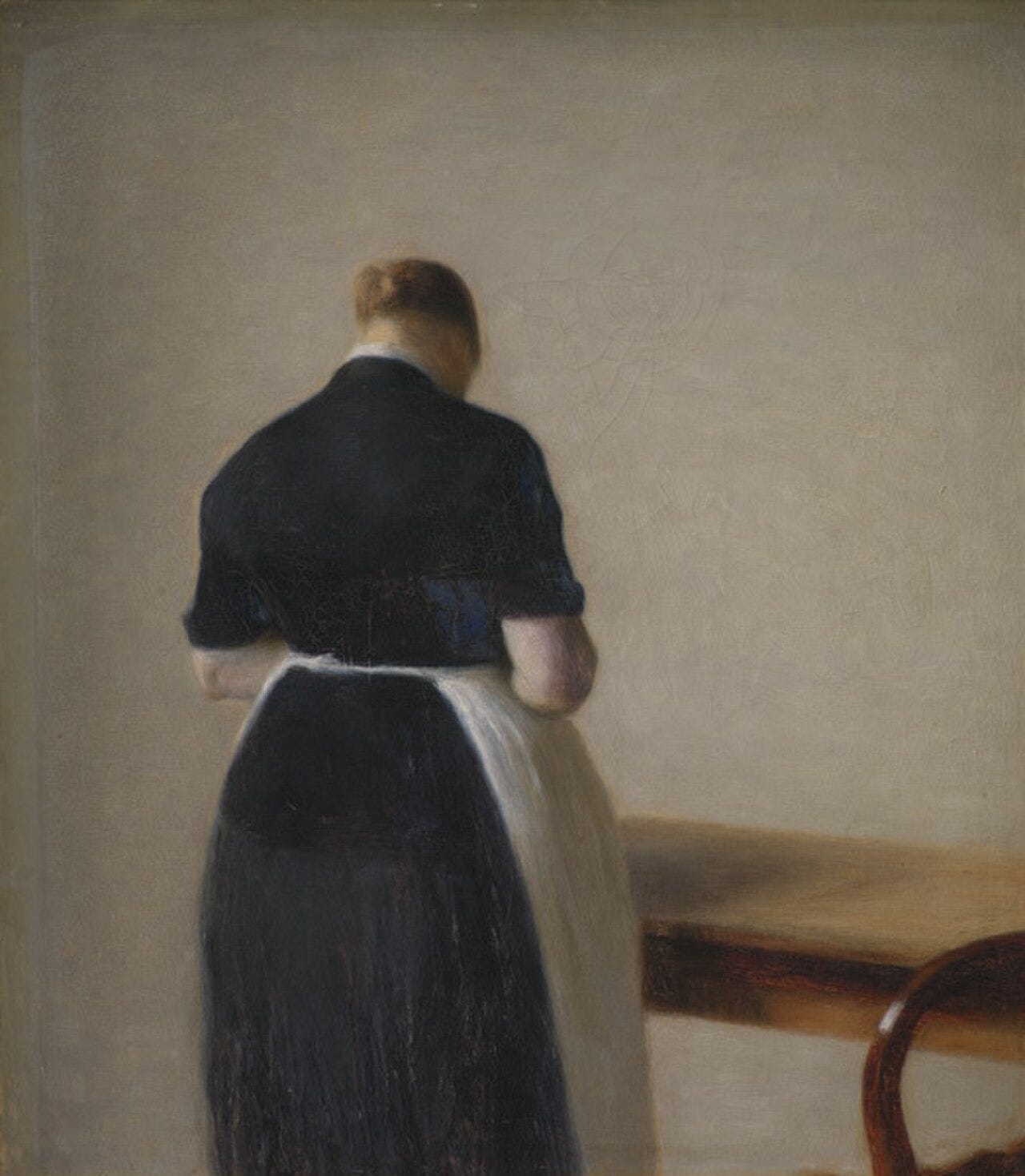
A woman stands with her back to us in a Copenhagen room, the light lying flat and grey on the floorboards. We never see her face. In Vilhelm Hammershøi’s Interior with Young Woman Seen from the Back (1903–04, Randers Kunstmuseum), nothing happens. A door, a wall, a pale patch of window light, a figure who will not turn round.
The poet Rainer Maria Rilke admired Hammershøi enough to go looking for him in 1904. Around the same time he was writing the letters later collected as Letters to a Young Poet. They hold the idea this piece is about: live the questions. In one plain sentence, Rilke asks you to stop forcing an answer you are not yet ready to receive, and to let the question be part of your life while it ripens.
The Ache of the Open Question
Whether to take the job in Aarhus or stay put. Whether to write to him again. Whether any of this effort is going anywhere. It has sat open for months, and meanwhile everyone around you seems to have decided their own life. A friend just bought a flat. Another told you over coffee, in a flat confident voice, exactly what she’s doing next year.
Each week without an answer feels like failing a test nobody set. Around midnight I open the same notes file, read the same two columns of pros and cons, and close it.
A question that stays open for months doesn’t mean your life is broken. It may mean it’s still being worked out.
Who the Young Poet Was
In the letter of 16 July 1903, Rilke is writing to Franz Xaver Kappus, a young man of about nineteen who had sent him verses and asked what to do with himself. Kappus wanted a verdict. Was he a poet? Should he continue?
Rilke’s reply, as best we can paraphrase it, turns the request over. He tells Kappus to be patient with everything unresolved in his heart, and to try to love the questions themselves, like locked rooms or books written in a language he does not yet read. The answers cannot be given to him now, because he could not live them. The point, Rilke says, is to live everything, and by living the questions you may gradually, without noticing, live into the answer someday.
That is nearly the whole letter. Kappus asked for a verdict and got patience.
Patience Is Not Passivity
You could read this as permission to drift, but Rilke isn’t giving that. The woman in Hammershøi’s room is not asleep. She stands, attentive, her posture upright, in light that has clearly been arriving for hours.
Patience in Rilke’s sense is quiet work. You go on with your days, you look at what is in front of you, and you don’t haul the question into a verdict before it has taken any shape. A bulb in winter soil isn’t procrastinating.
Hurry makes the question lie to you. Waiting lets it show what it is.
Why Answers Can’t Be Given Yet
Rilke doesn’t say the answer is hidden. He says it can’t be given to you yet, because you couldn’t live it. An answer handed over today would sit in your life like a sofa from someone else’s flat.
Remember the speech you rehearsed in the shower last week, the one that sounded so decisive. It felt good for an hour. Then a phone call, or a strange afternoon, or plain tiredness, and it fell apart. The question had moved on without you.
A forced answer is often a reply to last month’s question.
So demanding an answer at once tends to give you a wrong one, or a right one you hold too tightly.
Living Into the Answer
Back in the painting, the woman does not face us, and the picture is better for it. If she turned, we would read her expression and decide what she felt. Instead we stay beside her, in the same light, and wait. Hammershøi gives us the room and leaves the rest to us.
Living into an answer looks small from outside. You keep working. You notice what lifts you and what drains you, and you don’t turn either into a ruling. After a month you check which way the question has leaned, the way a pot plant ends up crooked toward the glass.
None of this excuses you from deciding. Some questions do need a deadline, and knowing which ones is its own skill. On Wednesday, the paid episode takes up exactly that difference, along with how Rilke’s patience held up across the letters and what he saw in Hammershøi’s rooms. If you want it, Get 25% off for 1 year.
One Small Thing for Tomorrow
Tomorrow, when the open question rises, say at the sink or on the stairs, do not argue with it. Give it one sentence, something like: still open, still here. Then get on with the next small job.
If that feels like cheating, try it for a week.
What stays with me about Rilke’s letter is how undramatic it is. No breakthrough, no decision, just a young man told that his unfinished life isn’t a failure.
If this sounded like your own month, restack it for someone who has a question of their own sitting open.