


He doesn’t know what to do with his arms.
They just hang at his sides, the white sleeves falling past his wrists. He’s a clown in a loose suit of shiny white satin, standing on a little rise of ground, facing us. Behind him and lower down, his fellow actors chat and fool around. One rides a donkey. None of them seem to notice him.
He’s looking at us.
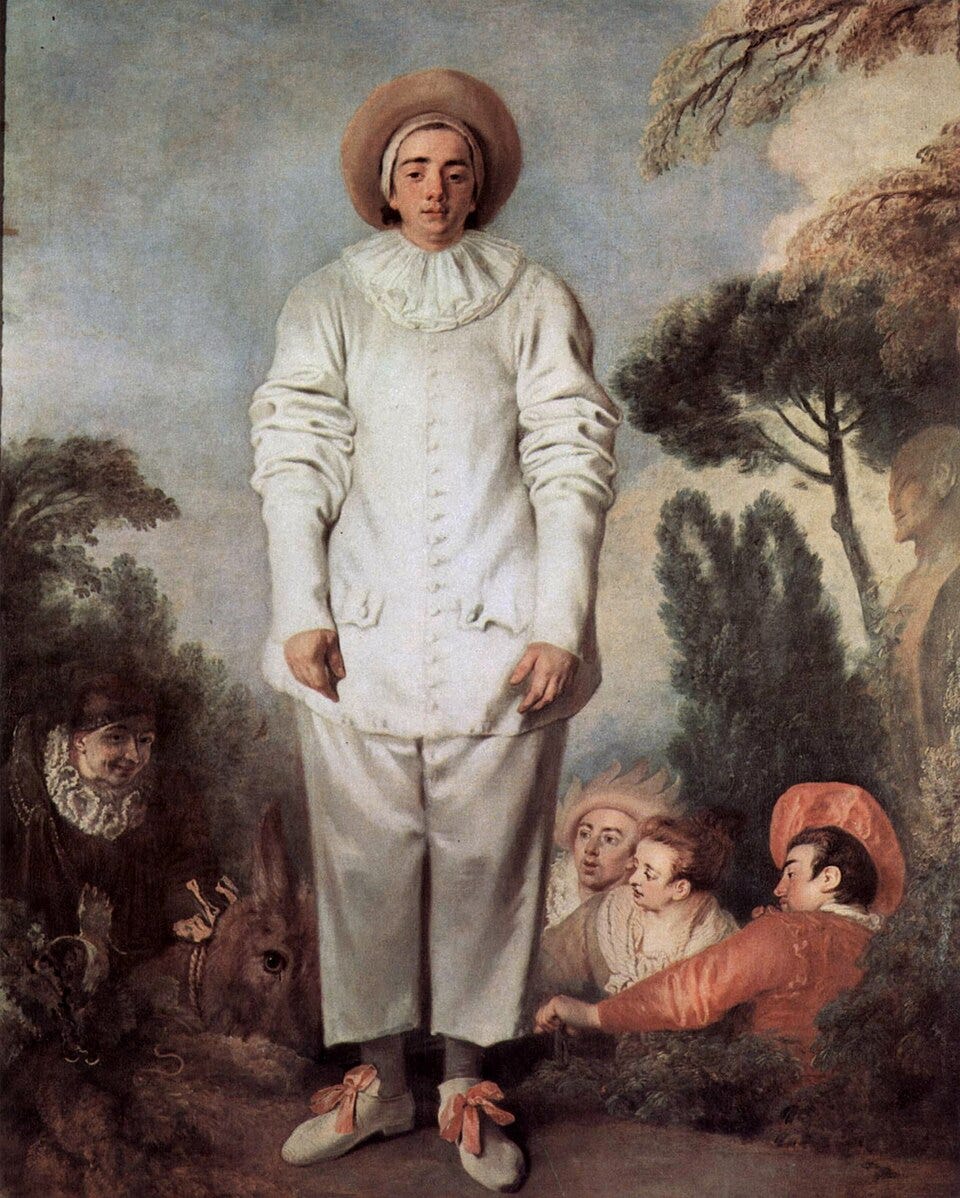
This is Pierrot, painted by the French artist Jean-Antoine Watteau around 1718 or 1719. Pierrot was a regular character in Italian comedy: the sweet, simple servant who always gets fooled. The canvas is big, and he’s close to life size. It hangs in the Louvre, the great art museum in Paris, where for a long time it went by the name Gilles, another clown.
What gets people is his face. He seems to be waiting. For a laugh, maybe. Or just a sign that he’s doing all right.
Most of us know that face from the inside.
The Waiting Face
Think about the people whose good opinion you’d hate to lose. A partner. A parent. A boss. With each one, you probably have your own version of Pierrot’s pose: arms still, smile ready, watching how you’re landing.
Here’s the strange part. The harder you watch, the worse it tends to go.
You rehearse the text message four times. You laugh a beat too early. You agree with something you don’t believe. The other person can feel the effort, even if they can’t name it. They start to feel handled.
So they pull back a little. So you try harder.
An English thinker spotted this trap about 150 years ago. He was writing about pleasure, and the trap is the same one.
The Slipping Prize
Henry Sidgwick taught at Cambridge, one of England’s oldest universities, in the late 1800s. In 1874 he published The Methods of Ethics, a long book about how we decide what we ought to do.
In it he points out something odd about pleasure. Aim straight at it and you tend to miss. He wrote that “the impulse towards pleasure, if too predominant, defeats its own aim.” Later writers named this the paradox of hedonism. (Hedonism just means making pleasure your main goal in life.)
Picture a game of tennis. The fun comes when you care about getting the ball over the net. Spend the match asking yourself whether you’re having fun, and the fun leaks out of the court.
Approval behaves the same way. It mostly shows up as a side effect. It comes from being honest, or from being truly interested in the person in front of you. Chase it head on and you become Pierrot on his little hill, waiting for applause that the waiting itself has made less likely.

That’s the bad news. The good news is hiding in the people we already trust.
Off Stage
Think of the people you trust most. Odds are they aren’t performing for you. They disagree with you to your face. They’ll tell you there’s spinach in your teeth.
Their approval counts because they could hold it back. When they say “that was good,” you believe them.
We miss this when we’re scared. Someone who’s always performing for us feels a bit slippery. And when we perform for the people we love, we feel slippery to them.
Watteau may have known something about this. Friends described him as shy and restless, and he died at 36, most likely of a lung disease. He painted actors his whole working life. Yet his most famous one has stopped acting. Pierrot isn’t doing a bit. He’s just standing there, and three hundred years later, people still find him easy to trust.
So here’s one thing to try this week.
Pick one conversation with someone whose approval you worry about. Before it starts, choose one thing about them, or about the topic, that you’re really curious about. Ask about it. Then listen until they finish, without planning your next line.
You’ll feel the urge to check how you’re doing. Let it pass, the way you’d ignore a phone buzzing in another room.
Then watch what happens to their face.

I remember a reference to this figure in a novel by Jose Revueltas called En Algún Valle de Lagrimas. In Some Valley of Tears.
Nicely word-smithed. It reminds me of a horse I once knew. My direct efforts to befriend her resulted recoil. I finally won her over by just being there for her. ❤️