


You’ve blown out hundreds of candles. Birthday cakes, power cuts, a dinner that ran late into the night. You probably never looked closely at a single one.
Why would you? A candle is about as plain as objects get. You light it, it burns, you forget it.
Learning can go the same way. At school, a new fact once felt like finding a coin in the street. Somewhere along the way it turned into homework, then into work. Now it’s a course you should finish, a language app nagging you at 9 p.m., a book you’re “getting through.”
Most of us know that flat feeling. The facts still go in. The spark doesn’t.
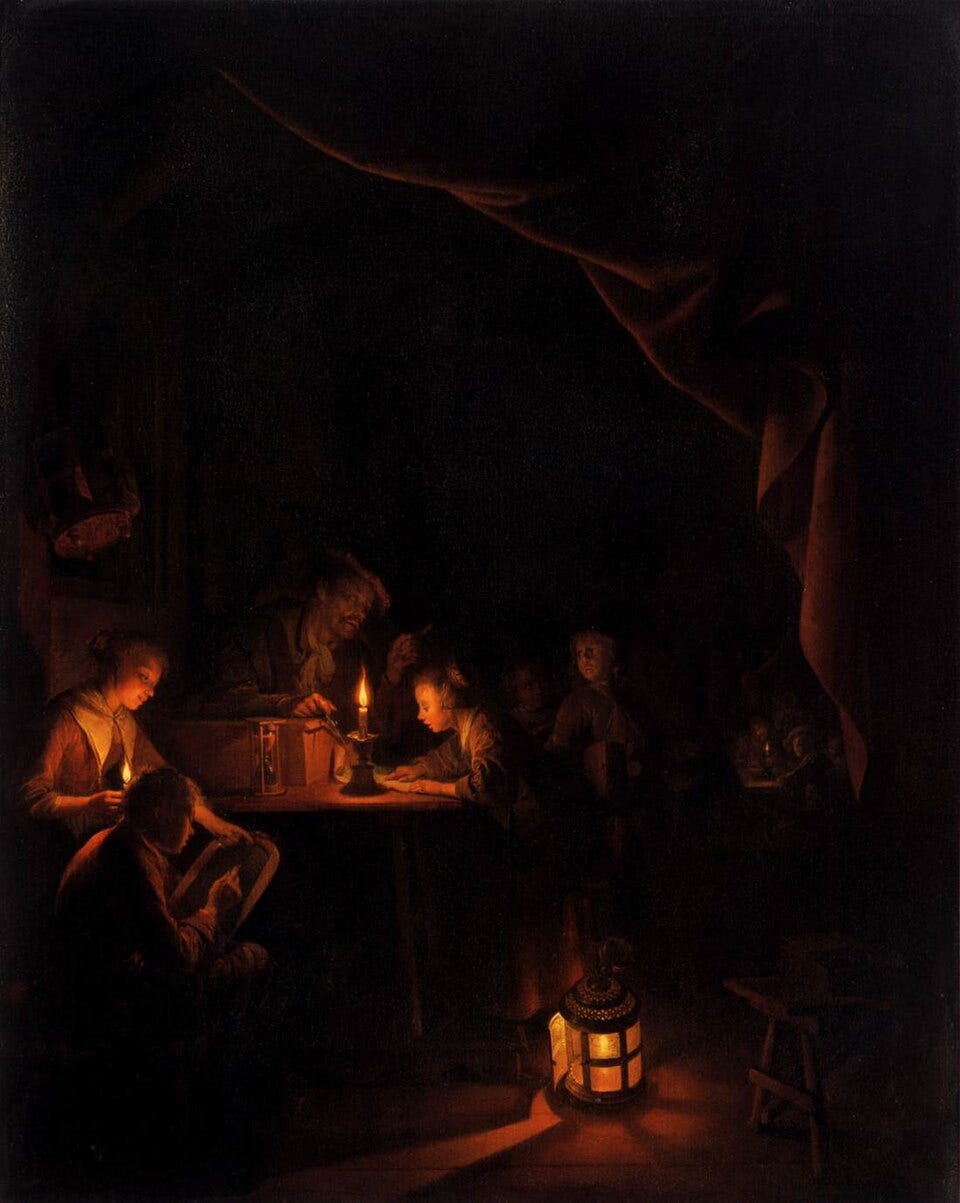
Stand in front of this one with me. The first thing you notice is the dark. Almost the whole panel is brown and black, like a room after the lights go out.
Then your eye finds the glow. A small flame throws warm orange light onto a few faces. Children lean over their lessons. One holds up a page to catch the light. Further back, other figures fade into shadow, half seen.
Gerrit Dou was Rembrandt’s first pupil in Leiden, a Dutch university town. He became famous for scenes like this, lit by one candle. He painted so finely that people said he waited for the dust to settle before he began.
Look at the faces again. Nobody here is bored. The light is small, so everyone leans in.
That leaning in is the thing we lose. A man in London knew how to get it back, and he used the same tool Dou painted.
Faraday’s Candle
Michael Faraday was a blacksmith’s son. He left school young and worked for a bookbinder, a man who sewed and covered books. Faraday read the books he was binding. That was his real school.
He went on to become one of the great scientists of his century. His work on electricity and magnets helped make the electric motor possible.
In the winter of 1860, Faraday gave a set of Christmas talks for young people. He gave them at the Royal Institution, a London home for science lectures that still holds these talks every winter. He was almost seventy. His whole subject was one candle.
He didn’t treat it as a small subject. He asked the kind of questions a child asks and adults stop asking. Why does the melted wax sit in a neat little cup instead of running down the side? His answer: air rushes up around the flame and cools the edge, so the rim stays solid.
Then he showed that the dark middle of the flame is full of wax that hasn’t burned yet. He slid a thin glass tube into it and drew some out. He lit the far end of the tube, and a second little flame appeared there.
He told his audience there was no better door into the study of nature than a candle.

So the candle wasn’t dull. We had just stopped asking it anything.
One Question
Here’s what to try this week. It takes ten minutes.
Light a candle somewhere safe. Watch it for five minutes without your phone. Each time you wonder something, write it down. Why is the flame shaped like a drop? Why is the bottom bluish? Where does the wax go?
Don’t look anything up yet. Just collect questions. Most people are surprised how many they find.
Then take the habit back to whatever you’re learning. Before you open the chapter or start the lesson, write one question you actually want answered. Make it your own question, the kind you’d ask a friend.
Faraday didn’t bring wonder to the candle from outside. He found it by asking one plain question, then the next one.
Your Spanish verbs, your history course and your spreadsheet skills all have a cool rim and a dark middle somewhere. You won’t find them by getting through the material faster.
Look back at Dou’s children, bent close to that small light. They aren’t racing to the end of the page. They’re leaning toward the one bright spot in the room.
