


The world map you know is a lie. Not a deliberate one, but a lie of perspective. We’re taught to see the world as a patchwork of countries—solid masses of land separated by empty blue voids. This is a land-dweller’s illusion.
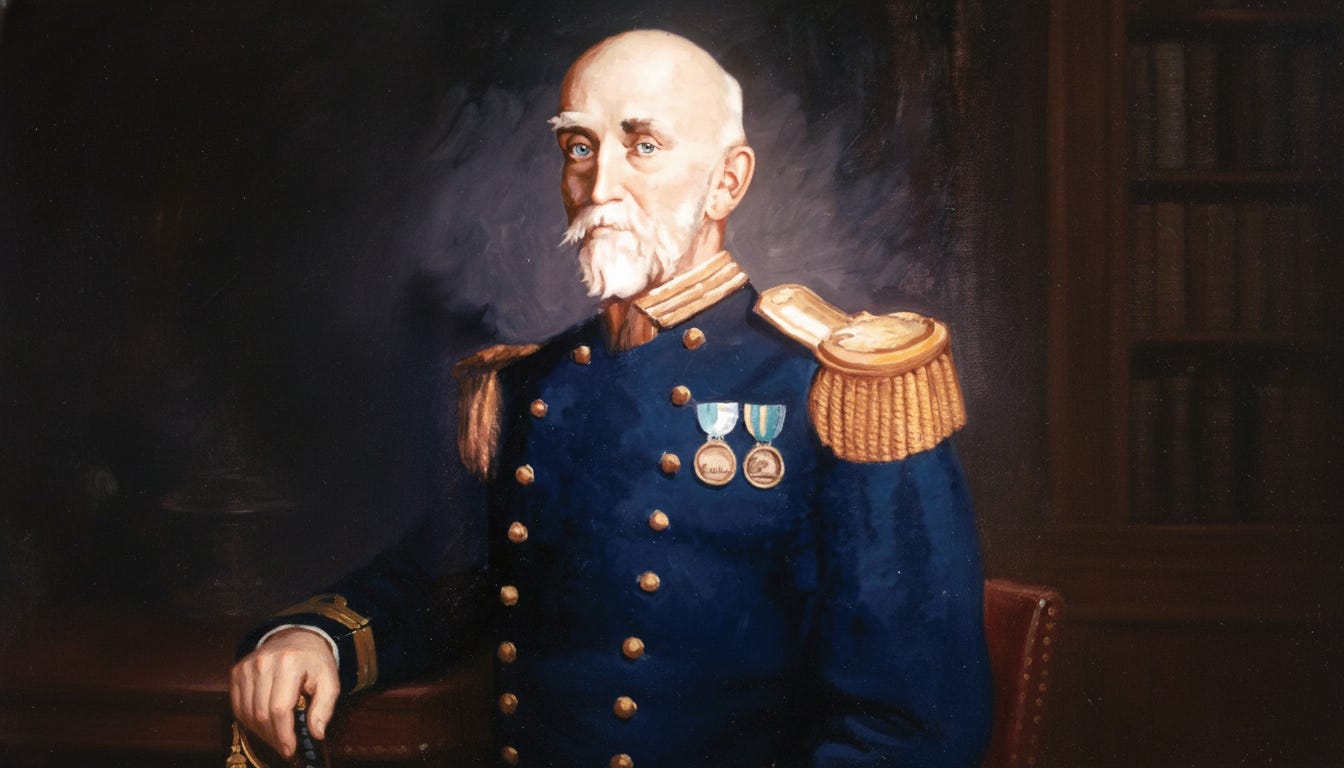
In 1890, a quiet, overlooked American naval officer named Alfred Thayer Mahan published a book that flipped this map upside down. He argued that the continents were mere islands. The great blue voids were not barriers; they were highways. The oceans, he proved, were the true chessboard of global power. And he didn’t just describe history; he handed the world a repeatable formula for empire.
The Engine of Command
Before Mahan, history was a story written in mud and blood. Power was measured in armies and borders. Mahan saw a different engine at work. He demonstrated how a nation could create a perfect, self-sustaining loop of power: a thriving merchant marine generates wealth, that wealth funds a powerful navy, and the navy protects the commerce while securing overseas bases. Commerce, Navy, Bases. This was the trinity.
He didn’t just theorize. He identified the six non-negotiable conditions—gifts of geography and national character—that a nation must possess to become a true sea power. If you had them, you could command the world. If you didn’t, you were destined to be a piece on someone else’s board. What were those conditions? And what was the brutal, violent endgame his doctrine demanded of a nation’s battle fleet?
The Whale and the Elephant
Mahan’s formula seemed final. The future belonged to the sea. But just as his ideas were being weaponized by rising powers like America and Germany, a different mapmaker in London offered a terrifying counter-theory. He saw that the great landmass of Eurasia—the “World-Island”—was a fortress that sea power could never conquer. A great dialectic was born: the whale versus the elephant, sea power versus land power. The clash between these two ideas would define the next century of war.
Who rules East Europe commands the Heartland; who rules the Heartland commands the World-Island; who rules the World-Island commands the world.
— Halford Mackinder


An Order Built on Water
The phone in your pocket, the fuel in your car, the entire architecture of our globalized life rests on the silent, invisible system of maritime control that Mahan blueprinted. For 75 years, this system has been underwritten by a single sea power, creating an era of peace and prosperity so complete we forgot it was an artificial construction.
But that era is over. New challengers are building fleets, establishing bases, and weaponizing the very choke points that sustain our world. To understand the headlines, the trade wars, and the geopolitical earthquakes of our time is to understand this hidden game.
You realize, with a sudden, chilling clarity, that the peace you have always known was never an accident. It was an outcome.
The blueprint was never forgotten by those who seek to redraw the map. It was only forgotten by those who live inside the world it built. The full story of this formula—how it was censored, how it clashes with land power, and why it is now more contested than ever—is the essential knowledge for navigating the century ahead.