


Some paintings shout at you from across the room. This one barely clears its throat.
It’s small and dark, and at first it looks almost empty. Then you step closer.
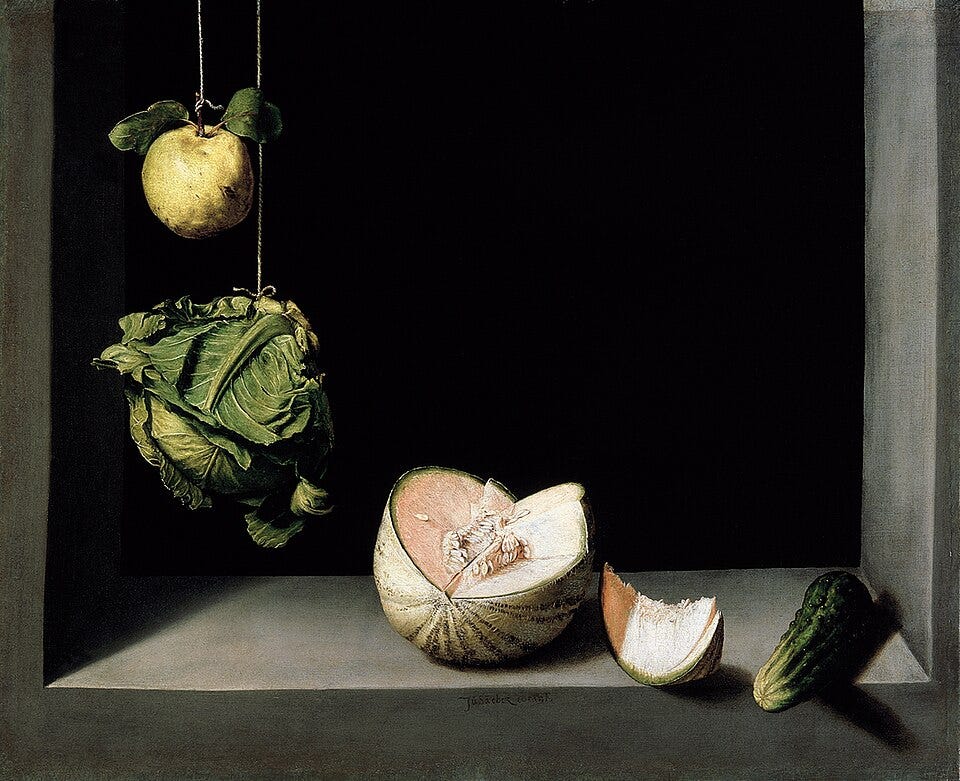
The Window
A stone window frame, painted in soft grey, sits in front of pure black. Two things hang inside the frame on strings. On the left is a quince, a hard yellow fruit that looks like a lumpy pear. Next to it, a little lower, hangs a big green cabbage. Its outer leaves curl open like a coat left unbuttoned.
A melon sits on the ledge below. One slice has been cut out and leans beside it. A cucumber pokes out past the edge, as if it might roll toward you.
Now look at the line they make. Start at the quince. Drop to the cabbage, then the melon, then the cucumber. It’s a gentle curve, like a ball bouncing down a staircase.
The painter was Juan Sánchez Cotán, working in Toledo, Spain. Pictures like this are called still lifes. That just means paintings of things that don’t move, like fruit, bowls and bread. Soon after, he left his busy career and joined the Carthusians, monks who live in near silence.
Nobody in the picture is doing anything. And still it holds you. The cabbage leaves catch tiny bumps of light. The cut melon looks wet at its edge. You start to feel he looked at these things for a very long time.
Which raises a question. How do you look at a cabbage that long without getting bored?
Gentle Looking
Nearly two hundred years later, a German writer had an answer. Johann Wolfgang von Goethe is famous for his poems and plays. He also spent years studying plants, rocks, clouds and colours.
His habit was simple. Before deciding what a thing was, he looked at it again. And again. He watched a leaf the way you’d listen to a good friend, without rushing to reply.
He had a name for this. In English it’s often called “delicate empiricism”. Empiricism means learning by looking and testing. It’s how you check if pasta is done: you taste it. Goethe added the word delicate. Look carefully, he meant, but gently. Don’t squeeze the thing into a box too fast.
He also wrote that every object, well looked at, opens a new organ inside us. In plain words, careful looking trains your eyes to see more.
That seems to be what Sánchez Cotán did with a cabbage.
It’s also something most of us quietly stopped doing around the age of seven.

One Minute
Most of us want slower days. We picture a week off, a long walk, a quiet cabin. Then Monday arrives and nothing changes.
The painter and the poet point to something much smaller. One minute, and something ordinary.
Try it today. Pick an object near you. An apple, a mug, a key, an onion. Set a timer for sixty seconds.
For the first twenty seconds, don’t name it. Just see shapes and colours. Where is it darkest? Where does the light sit?
For the next twenty, find one thing you never noticed. A scratch. A second colour hiding under the first. A small dent from the day it got dropped.
For the last twenty, think about where it came from. The apple hung on a branch through rain and sun. Someone, somewhere, shaped that mug.
Then stop. Put it down.
The first time, a minute will feel long. You may feel a bit silly staring at an onion. That’s fine. Most people do.
By the third or fourth try, something shifts. The object stops looking like stuff you own. It starts to look like something with its own small history, sitting right there beside you.
Sánchez Cotán hung a cabbage in a window and gave it the care other painters gave to kings and saints. You can give an onion sixty seconds on a Sunday afternoon.
It won’t fix your whole week. But one ordinary moment might feel like yours again.
If you like this kind of thing, Philosopheasy sends one idea a week in plain words, to use before Friday. You can try it free.

This reminds me of husserls or later heideggers phenomenology, to discover the essence of something by focusing on what is there.
Super interesting!