
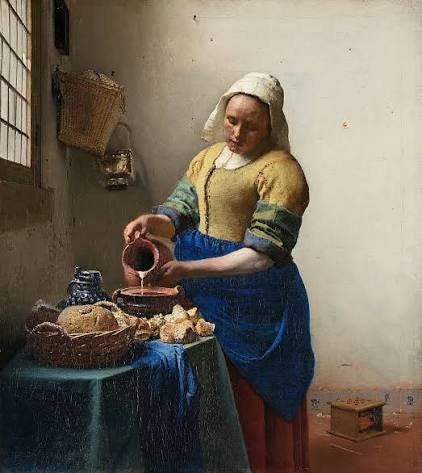
There’s a nail in the wall behind her. Just to its left, a tiny hole shows where another nail used to be.
The Thin Stream
The woman is a kitchen maid in a Dutch house. Johannes Vermeer painted her around 1658 in Delft, a small town in the Netherlands. She pours milk from a jug into a wide clay bowl. The stream is thin as a thread.
She isn’t famous. We don’t even know her name.
Look at what Vermeer gave her anyway. Dots of light sit on the bread crust like crumbs of sun. Her sleeves are pushed up past the elbow. On the floor sits a little foot warmer, a wooden box that held hot coals. One pane in the window is cracked.
Most of us walk past people like her every day. The cleaner at the station. The woman who stacks shelves at night. We don’t dislike them. We just don’t see them.
Vermeer slowed down long enough to see one.
That sounds lovely. But what would happen if you saw everyone?
The Roar
George Eliot asked that question. George Eliot was the pen name of Mary Ann Evans, an English writer of the 1800s. Her big novel, Middlemarch, came out in parts in 1871 and 1872. It follows a small English town full of people who want to do good.
In one passage she imagines hearing all of ordinary life at once. It would be like hearing the grass grow and a squirrel’s heart beat. “We should die of that roar which lies on the other side of silence.”
Her answer is blunt. “The quickest of us walk about well wadded with stupidity.” Wadded means stuffed with padding, like a winter coat.
Eliot lived close to science. Her partner, George Henry Lewes, wrote books on how bodies and minds work. She knew our eyes and ears let in only a sliver of the world. If they let in more, we couldn’t get out of bed.
So the padding keeps us sane. It also hides real pain. Right now, somewhere near you, someone is quietly going under. You’ll never read about it.
Some people tear the padding off and set out to fix everything at once.
Eliot wrote about one of them too.

Small Acts
His name is Tertius Lydgate. He’s a young doctor who comes to Middlemarch with big plans to change how medicine works. He’s clever and he means well. He also doesn’t listen much.
He marries in a hurry. He borrows money from a banker he doesn’t really know. When the banker’s secrets come out, Lydgate gets dragged down with him. His big plans shrink to almost nothing.
Rushing at the roar can add to the noise.
Eliot’s heroine, Dorothea Brooke, also starts out wanting to change the world. She ends up living a quieter life. Eliot doesn’t call it a failure. On the last page she writes that “the growing good of the world is partly dependent on unhistoric acts.” An unhistoric act is one that never makes the history books.
Things are better than they might be, she says, “half owing to the number who lived faithfully a hidden life, and rest in unvisited tombs.”
Look back at the maid. She’s pouring slowly so none of it spills.
So here’s something to try this week. Pick one person whose work keeps your days running and whom you barely notice. Learn one true thing about their day. Ask before you do anything to help. Then do only the part they ask for, and do it well.
You won’t hear the whole roar. Nobody can.
But you can hear one heartbeat clearly, and that one you can answer.