


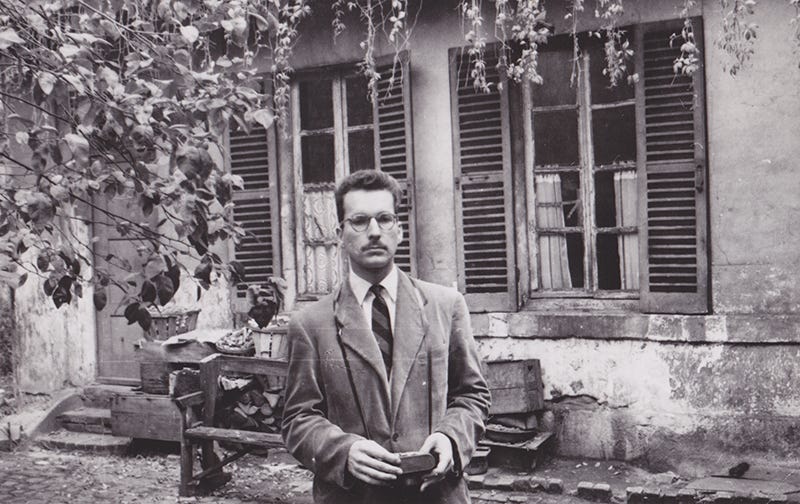
Every monument we build, every career we chase, every legacy we attempt to secure is part of a desperate, unspoken bargain with oblivion. We tell ourselves these are pursuits of meaning, success, or progress, but what if they are merely elaborate distractions?
According to the cultural anthropologist Ernest Becker, our entire civilization is a sophisticated, symbolic fortress built to deny a single, terrifying truth: our own mortality. Our ambition is not a noble reach for the stars, but a frantic attempt to build a self that will not perish with the body—a heroic lie we tell ourselves to keep the existential terror at bay.
The Grand Synthesis of Ernest Becker
Human ambition, according to anthropologist and cultural critic Ernest Becker, is intricately linked to a fundamental fear of death. His groundbreaking work, particularly his Pulitzer Prize-winning book The Denial of Death (1973), posits that this fear is not just a psychological obstacle but a primary motivator behind human creativity and ambition. Becker argues that in confronting the inevitability of death, individuals engage in various cultural and personal endeavors, striving for significance and immortality through their achievements and legacies. His ideas have sparked considerable interest in fields ranging from psychology to existential philosophy, making his contributions notable in understanding human motivation and behavior.
Becker’s philosophy merges existentialism and psychoanalysis, emphasizing that the anxiety surrounding death drives individuals to create cultural systems—such as art, religion, and societal norms—that offer comfort and a sense of continuity beyond mortal existence. He theorizes that this interplay between fear and ambition leads to a rich tapestry of human expression, wherein individuals seek to transcend their mortality through achievements that are celebrated within their cultural frameworks. However, this drive can also manifest in destructive behaviors when the pursuit of success becomes an obsessive escape from existential dread.
Despite the impact of Becker’s work, his theories have faced criticism for perceived biases, particularly concerning gender and sexuality. Some scholars argue that his analyses can be moralistic and fail to incorporate alternative perspectives, thereby limiting the discourse on death and human behavior. Critics contend that Becker’s views oversimplify the complex relationship between fear and ambition, often excluding important existentialist viewpoints that embrace authenticity through direct engagement with mortality rather than denial. This ongoing debate highlights the need for a more inclusive understanding of how individuals navigate the tension between ambition and the fear of death.
Becker’s legacy continues to resonate in contemporary discussions about the human condition, where his insights into death anxiety and cultural expression remain relevant. His interdisciplinary approach has fostered a broader dialogue about the complexities of existence and the mechanisms by which societies cope with mortality, offering valuable perspectives on how individuals can find meaning in the face of their fears. Through his exploration of the connections between fear, ambition, and culture, Becker invites us to reconsider our motivations and the ways we construct our legacies in an ever-fleeting world.
The Engine of Ambition
Ernest Becker (1924–1974) was an influential anthropologist and cultural critic whose work focused on the profound impact of death on human behavior and culture. His most notable contribution is the 1973 Pulitzer Prize-winning book, The Denial of Death, in which he argues that human ambition and creativity are deeply motivated by an innate fear of death and the quest for meaning in life.
