


Find the legs first.
They’re in the lower right corner: two pale shins kicking above green water, near a ship that doesn’t slow down. That’s Icarus, the boy who flew too close to the sun after his father Daedalus warned him exactly what would happen. The wax melted. He gets about a thumbnail of the canvas.
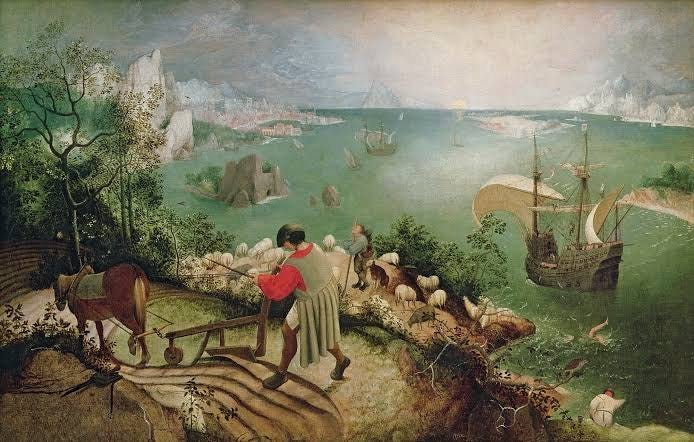
Nobody Looks
Everybody else is busy. A ploughman in a red shirt cuts furrows across the front of the picture, head down. A shepherd leans on his staff and gazes up at the sky, in the wrong direction. A man fishes at the water’s edge, line out, a short distance from a drowning boy.
Here’s the odd part. In Ovid’s version these same three men do look up. They see Daedalus and Icarus overhead and take them for gods. Whoever painted this took Ovid’s witnesses and turned every one of them away. Scholars now mostly think the Brussels canvas is an early copy of a lost Bruegel original.
In 1938 W. H. Auden wrote a poem about it. The ploughman, he says, “may / Have heard the splash, the forsaken cry, / But for him it was not an important failure.”
Judging the ploughman is easy. Saying when he became that man is harder.
The Heap
Sometime in the fourth century BC, Eubulides of Miletus asked a question so simple it still irritates philosophers.
One grain of sand isn’t a heap. Adding a single grain to something that isn’t a heap won’t turn it into one. So, by that reasoning, you can never make a heap. And yet the beach is covered in them.
We know frustratingly little about Eubulides. He belonged to the Megarian school, he quarrelled with Aristotle, and ancient sources credit him with the liar paradox and a bald man puzzle that works the same way. The Greek word for heap is soros, so the puzzle became the sorites.
Now run it on the ploughman. Not stopping for one splash doesn’t make you cruel. Keeping your eyes on the furrow one more time, when you’ve never looked up before, changes nothing. By that reasoning nobody ever becomes the person who doesn’t look up.
Yet here he is, ploughing.
Most moral blind spots form like this. Nobody sits down and decides to stop noticing the colleague who always gets talked over in meetings. You let it pass once because the meeting ran long. Then once more because it seemed like her business. Each grain is defensible on its own. That’s the trap.

Draw Lines
Philosophers have spent a very long time trying to dissolve the heap. Timothy Williamson, a logician at Oxford, defends a blunt answer: there really is a sharp line, one exact grain where the pile becomes a heap. We just can’t know which grain it is.
Whether or not he’s right about sand, his answer is the useful one for habits. If the line is real and invisible, you’ll never feel yourself cross it. So stop waiting for the feeling. Put a marker down ahead of time.
Try this. Pick one thing you’ve learned to step around. Maybe it’s the talked over colleague, or the neighbour whose curtains haven’t opened in a week. Write down every time this month you saw it and kept walking.
Then ask yourself a single question. If someone had come to me on day one and asked me to agree to all of this at once, would I have said yes?
If the answer is no, you’ve found your heap. The moment you’d be ashamed of has already happened, a few grains back, and it didn’t make a sound.
Now take the next grain and spend it differently. Say “hang on, she wasn’t finished.” Knock on the door with the closed curtains. One grain won’t undo a heap. Eubulides would point that out before you finished the sentence.
Bruegel, or whoever it was, left the ship under full sail and the legs still kicking. The picture never tells us whether anyone turns around.
