


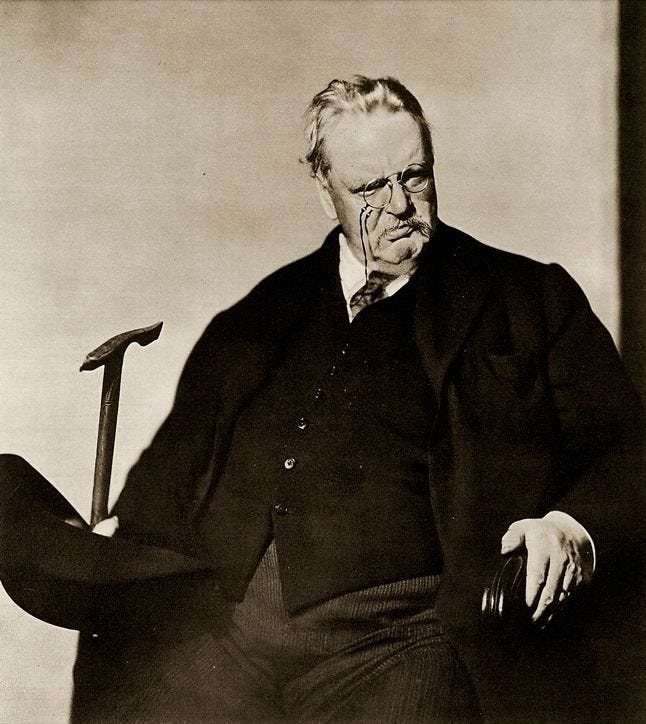
In an age that worships disruption and mistakes demolition for progress, the act of preservation has become a radical one. We are conditioned to see every old wall, every established custom, and every inherited tradition as an obstacle to be torn down in the relentless pursuit of the new. But what if the most revolutionary act is not to tear down a fence, but to first ask why it was built? This was the profound challenge issued by G.K. Chesterton, a thinker whose wisdom offers a chilling diagnosis of a modernity obsessed with its own cleverness, yet dangerously amnesiac to the accumulated intelligence of the past. He argued that before we can innovate, we must first inherit, and that our future depends on a principle of intellectual humility that we have almost entirely forgotten.
Background on G.K. Chesterton
G.K. Chesterton (1874-1936) was a prominent public intellectual and literary figure of the early twentieth century, known for his wit, eccentricity, and robust defense of religious belief in an increasingly secular world. His work spanned various genres, including novels, essays, and poetry, with notable contributions to detective fiction through his Father Brown series. Chesterton’s writing style is characterized by a keen sense of observation and a playful use of language, which often allowed him to challenge contemporary ideas and social norms.
Early Life and Education
Chesterton’s formative years were marked by a profound sense of wonder, which he recounted in his Autobiography, stating that his childhood was filled with the belief that “anything in [life] was a wonder” and that the world was “miraculous”. He studied at the Slade School of Art at University College London, where he faced a psychological crisis during the 1890s due to the prevailing cultural atmosphere of Decadence and Pessimism. This experience ignited a desire in him to create his own mystical theory, which ultimately led him to embrace a worldview that found the extraordinary in mere existence.
Intellectual Influence and Contributions
Chesterton was a prolific writer and a sharp critic of modernity, articulating his thoughts on the unraveling of Western thought and culture. He often warned against the dangers of a purely rationalistic approach to existence, arguing that it led to moral and existential confusion. His critiques were prescient, as he lived to witness the consequences of the prevailing ideologies of his time, which he felt were misguided. Bernard Shaw, a contemporary and critic, acknowledged Chesterton’s intellectual prowess, calling him a man of “colossal genius”.
Philosophy and Beliefs
Chesterton’s philosophical stance emphasized the importance of tradition and the wisdom it encapsulates. He distinguished between the thinking of the sane man and that of the maniac, advocating for a form of reasoning that progresses through observation and wonder, rather than starting from a preconceived conclusion. His belief in the value of tradition as a repository of collective wisdom resonates through much of his work, urging a careful consideration of the past as a guide for the present and future.
The Importance of Tradition
Tradition plays a crucial role in connecting generations, preserving collective wisdom, and offering insights that may not be immediately apparent to modern society. G.K. Chesterton emphasizes the value of understanding the origins and purposes behind traditions before dismissing them. He argues that traditions are not arbitrary; they are the result of accumulated knowledge and experiences passed down through generations, embodying a form of collective intelligence that deserves respect and consideration.
Chesterton posits that to eliminate a tradition, one must first comprehend why it was established in the first place. This approach encourages a mindset of humility, where individuals seek to ask questions rather than make hasty judgments about the past. He asserts that many customs, often labeled as outdated or trivial, may actually hold vital survival knowledge that has been honed over centuries. This perspective invites a deeper appreciation for the cultural and historical contexts from which these traditions arise.
Moreover, Chesterton describes tradition as “the democracy of the dead,” signifying a collective vote that honors our ancestors and their contributions to our present. He argues that tradition is a living entity that refuses to
