


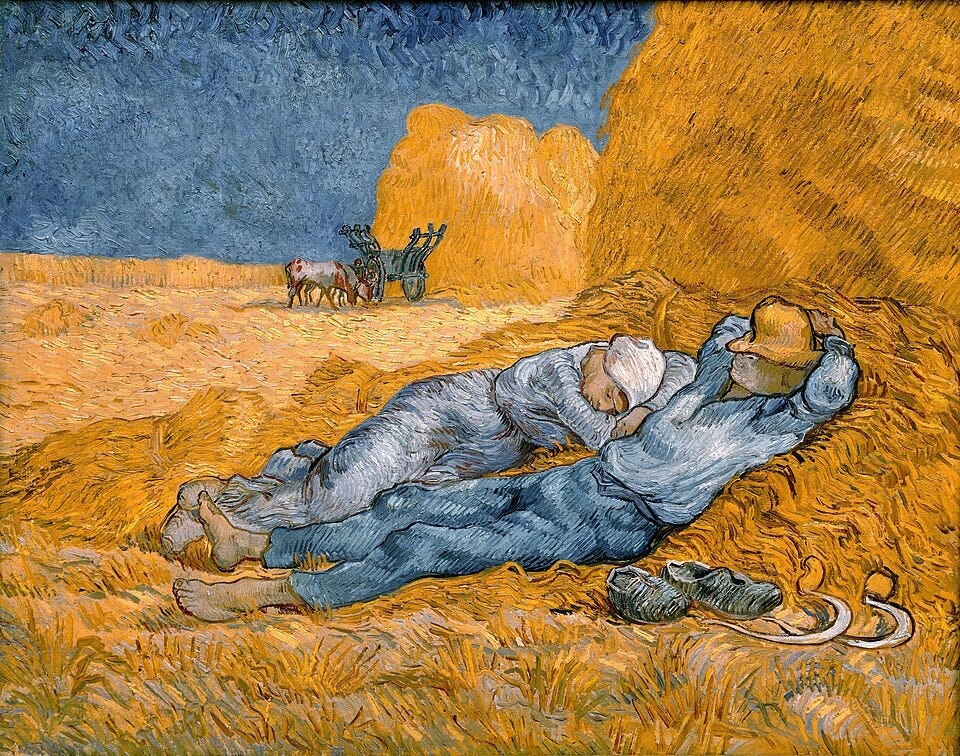
An hour-long podcast played at 1.5x lasts forty minutes. Check it on the app if you like. The twenty minutes you saved went somewhere, and I suspect it was into the next episode.
That is the Saturday I mean. Run at 8:15, logged. Meal prep boxes stacked in the fridge by noon, five of them, lids on. Podcasts all afternoon, faster than the people recorded them. By Sunday night the day off feels like a shift you clocked, and nobody even paid you.
You can spend a whole Saturday on yourself and still hand every hour of it to Monday.
What the Saturday felt like
None of it was a mistake. The run was good for me, and so was the food. Nobody could object to that Saturday.
But there was no slack in it. Not one hour was just an hour. Every task was something to tick off before the next one, and even the resting had a time slot and a number attached.
What Han noticed
The philosopher Byung-Chul Han wrote about this in The Scent of Time. His idea, in one sentence: modern time has broken into a string of separate points, each one only a step toward the next, so nothing lasts long enough to have a scent.
By scent he means the way some time hangs around. A moment with some length to it holds on to what came before and leans a little toward what’s next. Point-time holds nothing. Every moment is a stop on the way to somewhere else.
A day chopped into points never gets anywhere. Each one is just the way to the next.
Why optimised rest is still work
Take a Saturday walk. Your watch counts the steps and closes the ring, and the walk becomes something you produced, with a target behind it, even if a mild one.
Han’s argument is that when time is only points, an hour has no value of its own. It is worth what it leads to. So a day off gets judged as recovery, and recovery is judged by how ready it makes you for Monday.
A day off that exists to repair you for Monday still belongs to Monday. The boss just got swapped for your own good intentions.

Lingering, the old skill
Han’s answer is lingering: staying with something for no reason. The time isn’t spent on anything, and afterwards you’ve got nothing to report.
Think of the last meal that ran on too long. The plates sat there while the light went from yellow to grey and nobody got up. Ask what that hour achieved and you’d have nothing. That’s why it felt like rest.
Lingering is hard because it looks like waste. It’s the one thing you can’t log or track. And you can’t play an afternoon at 1.5x.
One thing to keep
If an hour has to justify itself afterwards, it was never really off. Rest, in Han’s sense, isn’t low effort. It’s time with nowhere to be going.
I don’t think the answer is to cancel the run or the meal prep. I would just stop treating them as the rest.
One small thing for tomorrow
Pick one stretch of twenty minutes. Make a cup of tea and sit with it until it goes cold. No podcast, no phone, no thinking about what comes after the tea.
You’ll probably check the time. Fine. It shows how far the points have got into you. Just don’t write it up afterwards, even in your head.
On Wednesday there is a longer audio deep dive for paid subscribers called The Lingering Kit, on how to build an hour with no output target and how to tell if your weekend has quietly been clocking you in. If you want to hear it, you can Get 25% off for 1 year.
If your own Saturday looked like this one, restack it.

True. Lingering does feel like an answer.
When I used to visit my grandma's home, we used to sit together in circle, on floor and eat. We waited for each one of member to come and join us, sometimes even neighbour. After eating, we used to talk. It almost took 1 hour . It felt so nice. After dinner, we would walk and then watch TV. It was never "productive" but the sleep I used to get after was brilliant.