


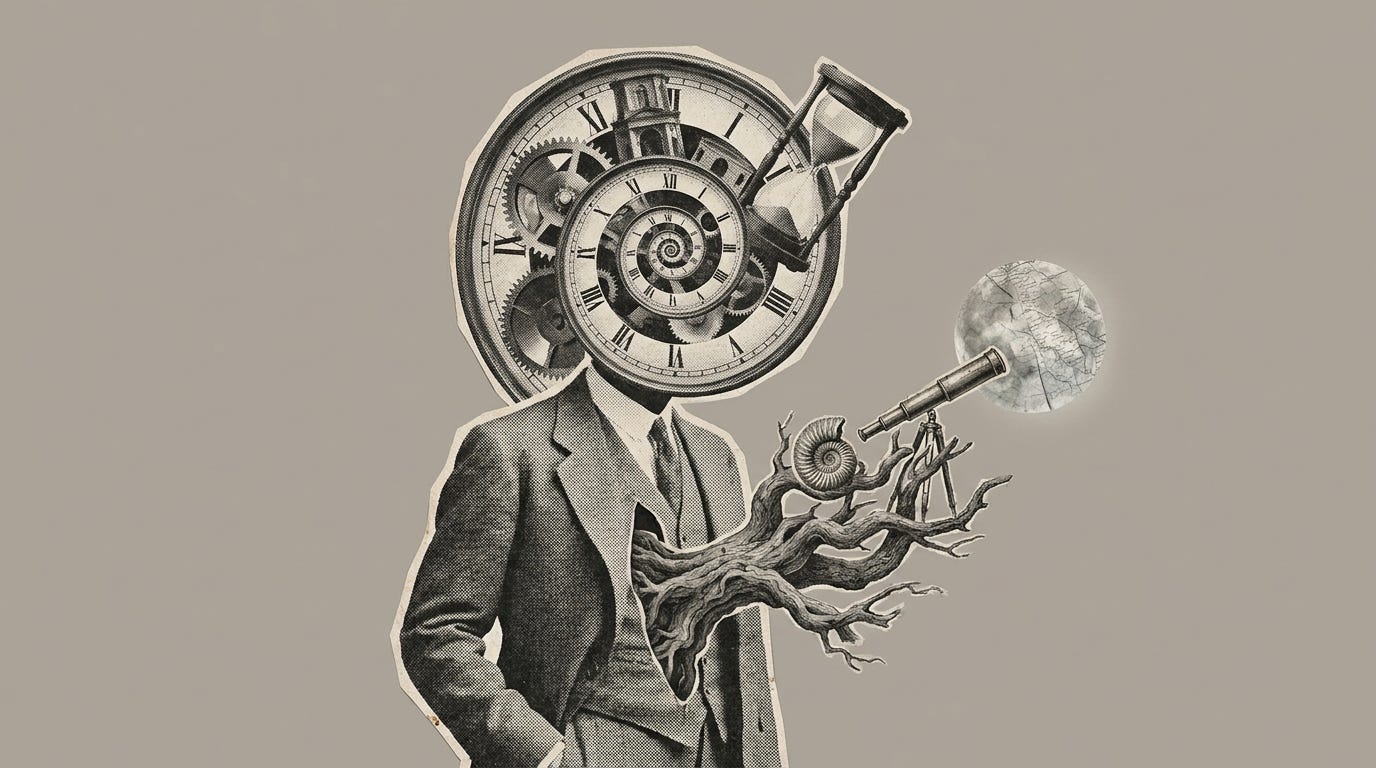
Most people experience the sensation of chronic time-poverty—the feeling that there is never enough time, coupled with a pervasive exhaustion that no amount of sleep can cure—as a purely private failure of scheduling, discipline, or boundary-setting. We download another productivity app, attempt another morning routine, and berate ourselves for lacking the willpower to “manage” our hours effectively, convinced that our burnout is a solitary defect in an otherwise functional world.
But the philosopher Byung-Chul Han, alongside the ancient Greek framework of time, suggests something far more unsettling: burnout is not a failure of personal productivity, but a profound spiritual crisis born from the totalizing colonization of Kairos (meaningful, deep time) by Chronos (relentless, measurable clock time).
This deep dive examines what happens to the human psyche when a life is lived entirely under the tyranny of the ticking clock, absent the rhythms of purpose. We will explore what the distinction between these two experiences of time actually means, why the erasure of deep time matters urgently today, where this friction appears in our modern obsession with “hustle,” our relationships, and our politics, and what fundamentally changes once you can name this invisible architecture clearly.
Inside this piece:
The Concept in Plain English: Unpacking the ancient distinction between Chronos (the time that consumes) and Kairos (the time that fulfills), and why English fails us by having only one word for both.
The Real Argument: How the modern economy didn’t just change the way we work, but actively flattened our perception of reality, turning time into a homogenous commodity that starves the human search for meaning.
Where It Shows Up Now: From the proliferation of “bullshit jobs” to the anxiety of the Sunday night dread, and the weaponization of “flow states” by corporate culture.
The Hidden Cost of Ignoring It: Why attempting to cure burnout with “time management” only deepens the pathology, leading to a profound crisis of purpose.
The Practical Lens: How to cultivate temporal sovereignty and design architectures of living that invite deep, resonant rhythms back into a hyper-accelerated world.
By the end of this session, you will be able to identify the invisible, systemic structure behind your exhaustion and burnout, instead of merely feeling its crushing effects.

Or save 25% and get 3 months free
The Invention of the Clock-Shaped Human
To understand the water we are swimming in, we must first look at the history of the current. For the vast majority of human history, time was not something one could “spend,” “save,” or “waste.” Time was an environmental reality, tethered to the natural world. It was cyclical, dictated by the rising and setting of the sun, the waxing and waning of the moon, the turning of the seasons, and the biological rhythms of the human body.
The ancient Greeks, possessing a profound psychological vocabulary, understood that human beings experience time in two entirely different dimensions. They gave us two words: Chronos and Kairos.
Chronos is quantitative time. It is chronological, sequential, and linear. It is the ticking of the second hand, the calendar, the schedule. Chronos is the time of aging, of decay, and of measurement. In Greek mythology, Chronos was the titan who devoured his own children—a fitting metaphor for how linear time ultimately consumes us all.
Kairos, on the other hand, is qualitative time. It is the opportune moment, the “right” time, the supreme moment of action or transformation. If Chronos is the timeline, Kairos is the vertical depth of a specific moment on that line. Kairos is falling in love, the sudden flash of creative insight, the feeling of losing yourself in a deep conversation, or the silence of a profound grief. Kairos cannot be measured by a watch; it is measured by its density, its meaning, and its resonance.
The tragedy of modernity is the story of how Chronos systematically hunted down and eradicated Kairos.
The shift began, ironically, in the pursuit of the divine. In the 14th century, European monasteries developed the first mechanical clocks to regulate the horae canonicae—the canonical hours of prayer. The monks needed to know exactly when to chant, regardless of whether the sun was shining or obscured by clouds. The mechanical clock was invented to synchronize humanity with God, but it inadvertently synchronized humanity with the machine.
By the time of the Industrial Revolution, the clock had moved from the monastery to the town square, and finally to the factory floor. The invention of the punch card and the hourly wage cemented a new, epochal paradigm: time is money.
Suddenly, time was no longer an environment; it was a resource. Every hour was identical to the next, stripped of its qualitative differences. An hour spent grieving was economically identical to an hour spent tightening bolts on an assembly line. This homogenization of time birthed the modern world—allowing for global logistics, scientific standardization, and unprecedented material wealth—but it required a brutal psychological reshaping. The human being had to become clock-shaped.
Today, in the era of the smartphone and the “always-on” digital economy, the colonization is complete. Chronos no longer just rules the factory floor; it rules the bedroom, the dinner table, and the bathroom. We track our sleep in hours and percentages; we listen to audiobooks at 2x speed to “save time”; we schedule 15-minute “catch-ups” with old friends. We have become masters of Chronos, and yet, we have never felt more starved for time.
