


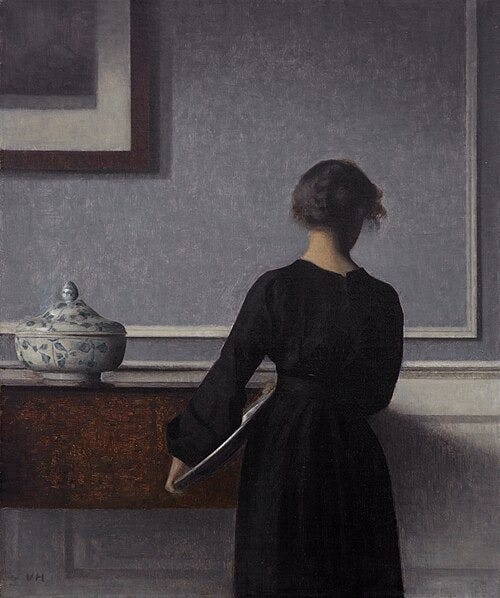
Suppose I give you a Sunday. Nothing booked, no one expecting you, the phone face down by choice. The only rule is that you stay in the room, in a chair, for the first ten minutes before you may do anything at all.
Watch what your hand does. Somewhere around minute three it will want to reach for something small: the dishwasher, the unread message, the drawer that has needed sorting since spring.
That reach is the subject of this essay. A seventeenth-century French mathematician spotted it, and he thought it explained a great deal more than a messy drawer.
The day you asked for
You have probably said it out loud: I just need one day with nothing to do. And then the day arrives, and by ten past nine you have wiped the hob, answered two emails that could have waited, and started researching a better kettle.
That’s not laziness. Nearly everyone does it. The empty day you begged for arrives, and you fill it before the tea has cooled.
Odd thing: the person who moans about a huge to-do list is usually a bit relieved it never runs out. A finished list would leave a gap, and the gap is the thing we are dodging.
What Pascal noticed
Blaise Pascal was a mathematician and physicist who also wrote a loose, brilliant set of notes on human life, published after his death as the Pensées (French for “thoughts”). In them he makes a claim that has become famous: that much of humanity’s trouble comes from our inability to sit quietly in a room alone.
His word for what we do instead is divertissement. It simply means diversion: whatever keeps us from thinking about our own condition.
He wasn’t telling anyone off. He looked at the most powerful people around him and found the same habit. Kings, he observed, are surrounded by people whose whole job is to keep them entertained and occupied, because a king left alone with himself becomes unhappy. If a king needs the distraction, so do the rest of us.

Busyness as a shelter
Busyness feels like a weight, and it is. Pascal’s twist is that it also works as a hiding place.
Quiet is where certain questions sit waiting: am I living the way I meant to? What’s it all for? And under those, that I’ll die, and so will everyone I love. Nobody learns any of this fresh. We just don’t want to sit with it.
Notice what a task does. It hands you a small, winnable goal, and a small goal leaves no room for a large question. A to-do list is partly a list of things to do and partly a list of reasons not to think.
Pascal also pointed out that we often chase the activity rather than the prize. The hunter does not really want the hare, he said; he wants the hunt. The errand is the point. That is why ticking one thing off never brings the calm you expected: the calm was never in the task.
One example, small enough to check
Take the Sunday from the start. You sit for three minutes, the urge arrives, and you get up to descale the kettle. The kettle did need descaling, maybe. But look at the timing. The urge did not arrive when the kettle got dirty. It arrived when the room got quiet.
That timing is the evidence. A job that is truly needed does not usually wait for the silence to announce itself.
If the urge to be useful shows up exactly when things go still, it may be a flinch rather than a duty.
The thing to keep
Busyness is not always avoidance, and Pascal never said work was worthless. Some of the list is real: the rent, the school form, the medication. What I’d keep is smaller than that. Sometimes the list is doing a second job, and you can notice it without beating yourself up. Kings did it. So do I.
Try this tomorrow
Pick one ten-minute gap you would normally fill. A kettle boiling, a bus that is late, the stretch before the first meeting. Do not fix it with your phone. Stand or sit, and let the urge to add a task come and go like weather.
You don’t have to come up with anything deep. Just stay put until the kettle clicks off. Afterwards, if you like, write down in one line what it felt like. Skip what it meant. Write down what it was like: restless, itchy, bored, whatever.
Ten minutes usually goes quicker than you’d think. If it drags instead, note that.
On Wednesday, the paid audio goes further into what diversion is covering, and the companion article is a working toolkit for the moment the urge to add a task arrives, including a full empty-room practice you can use the same evening. If that sounds useful, you can Get 25% off for 1 year.
If you know someone who refills the kettle just to avoid sitting still, restack this for them.
