


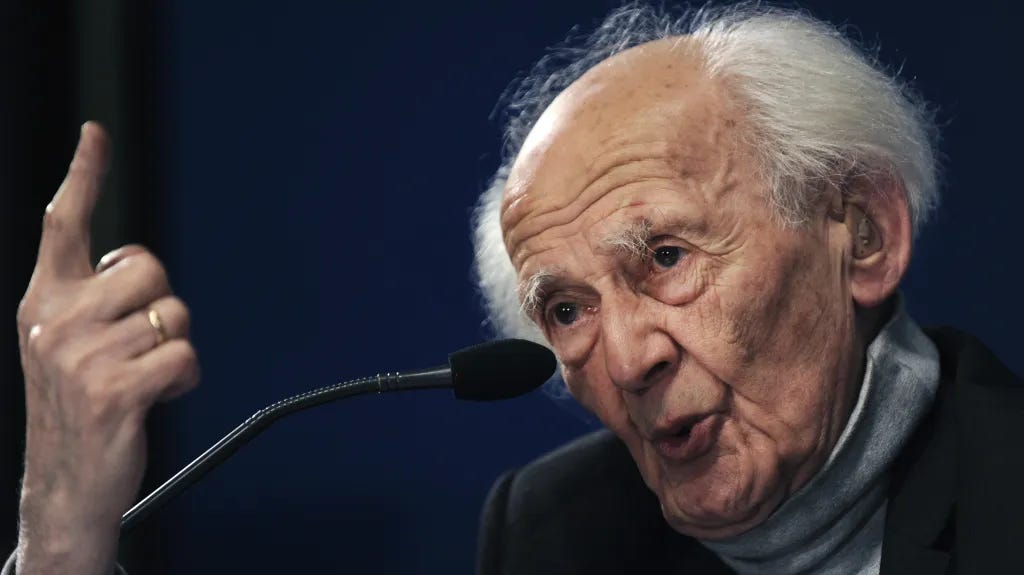
Imagine a world where the lines are blurred, where yesterday’s certainties have evaporated into a haze of unsettling ambiguity. We grew up with maps, with clear borders, with the distinct notion of “front lines” – places where soldiers clashed and territories were won or lost. War was a distant thunder, or a dramatic, defining moment. But what if the thunder never ends, and the battlefield is no longer a place, but a pervasive, unshakeable condition? Zygmunt Bauman, the visionary Polish-British sociologist, saw this coming. He spoke of the “liquefaction of borders”; today, we live in the “liquefaction of peace.”
The Solid Front Line: A Relic of the Past
For centuries, war was a largely “solid” affair. It involved armies, flags, and the explicit aim of territorial conquest. Think of pitched battles, sieges, and the dramatic narratives of D-Day landings. Victories were tangible: a city captured, a border redrawn, an enemy force decisively defeated. There was a clear enemy, a discernible objective, and a defined endpoint. Even in the Cold War, the front line might have been ideological, but its physical manifestation was clear, symbolized by the Iron Curtain or the Berlin Wall. This model, however, is increasingly becoming a historical artifact.
In a liquid modern life there are no permanent bonds, and any that are formed must be tied loosely so that they can be untied again, as quickly and painlessly as possible, when circumstances change.
— Zygmunt Bauman, “Liquid Modernity”
The Age of Liquidity: When Borders Dissolve
Bauman’s concept of “liquid modernity” posited a world where everything solid melts into air. Where institutions, relationships, and even identities become fluid, temporary, and constantly in flux. Unlike the solid modernity characterized by fixed factories, stable nation-states, and rigid social structures, liquid modernity dissolves these very foundations. War, too, has followed suit, shedding its solid form for something far more insidious and pervasive. It has transformed from a conventional clash of armies into something akin to “liquid” hit-and-run operations that seep into the very fabric of civilian life. Where are the clear distinctions when the battlefield is everywhere?
The Invisible Battlefield: Everywhere and Nowhere
The most unsettling aspect of this liquid war is its ubiquity. The front line is no longer a place on a map, marked by trenches or checkpoints. It is a condition of existence. Consider the unsettling trend of unexplained disruptions in seemingly stable nations: sudden train derailments, mysterious industrial fires, cyberattacks on critical infrastructure. These aren’t acts of declared war, yet they sow discord, disruption, and fear. They fit perfectly within Bauman’s theory, highlighting the pervasive uncertainty of late modernity. They are undeclared skirmishes in an invisible conflict, designed not to conquer territory, but to destabilize certainty itself.
The Weapon of Uncertainty: A Perpetual Siege
This new battlefield fosters a state of permanent low-level anxiety and disruption. We aren’t expecting a clear declaration of war or a decisive invasion. Instead, we live under a perpetual siege of uncertainty. The danger isn’t always overt; it’s the insidious erosion of trust, the constant questioning of what’s real, and the dread of the next inexplicable event. Uncertainty is the primary weapon in this liquid conflict. It is designed to overwhelm, to exhaust, to make us question our very foundations. How do you fight an enemy whose primary tactic is ambiguity?
Liquid modern society, like all societies, is a machine for fighting uncertainty; what is specific to it is that it generates a new kind of uncertainty, whose source is the very process of dismantling and liquefying all that was solid and fixed.
— Zygmunt Bauman, “Liquid Modernity”
Unlock deeper insights with a 10% discount on the annual plan.
Support thoughtful analysis and join a growing community of readers committed to understanding the world through philosophy and reason.
Navigating the Liquid War: A New Mindset
To confront this new reality, our approach to security, peace, and even daily life must fundamentally shift. We need to re-evaluate traditional risk assessment models, which are often built for linear, predictable threats. The old frameworks are ill-equipped for non-linear, liquid threats that prioritize disruption over dominance. This demands a profound change in our collective mindset.
The citizen must stop looking for a D-Day and start preparing for a perpetual siege of uncertainty.
What does this preparation entail?
Beyond Victory: The concept of “winning” a liquid war becomes largely obsolete. There’s no flag to plant, no surrender to accept.
Adaptation Over Conquest: Our focus must shift from ‘winning’ to ‘navigating’. Bauman, in his insights into fluid modern life, implicitly teaches us how to float amidst the currents rather than building rigid dams against them.
Clarity as Defense: If uncertainty is the weapon, then clarity—in thought, information, and purpose—becomes our most potent defense.
Community Resilience: Building robust, informed, and adaptable communities is paramount, as individual safety becomes intertwined with collective resilience.
The era of Bauman’s liquid war demands more than just new military strategies; it requires a radical re-evaluation of how we perceive peace, conflict, and security itself. The illusion of a geographically bounded front line has vanished, replaced by a pervasive, shapeless threat that infiltrates our daily lives. This isn’t a call to despair, but an urgent invitation to adapt. By understanding that certainty is no longer a given, and that fluidity is the new normal, we can begin to cultivate resilience, foster critical thinking, and build communities robust enough to navigate the choppy, uncertain waters ahead. The battlefield is indeed everywhere, but so too is the opportunity for informed, adaptable, and collective defense against the liquefaction of peace.
We were taught to look for battlefronts,
but war no longer announces itself.
Today, conflict hides within uncertainty,
and peace quietly dissolves into anxiety.
In a liquid world, survival is no longer about winning,
but about preserving clarity, dignity, and awareness.
When everything becomes unstable,
thinking with lucidity is an act of resistance.
It's quite sad to think that there isn't an end to all war (ik it's idealistic, as long as an organism has a mind there will be violence and unrest), rather we gotta accept and try to adapt to it. But would successfully adapting to it weaken the spirit to fight against it (since we are used to it) and eventually die as time goes on, since the future generations would only know this uncertain state?