


The Lamp
On Monday you’ll probably ask a machine to do something you used to do yourself. A summary. An email. The first draft of a plan.
It’ll be done before your coffee cools.
Then a small thought shows up. If it can do that, what else can it do? And what’s left for me?
People have stood in front of clever machines and asked that for a long time. Here’s one room where they did.
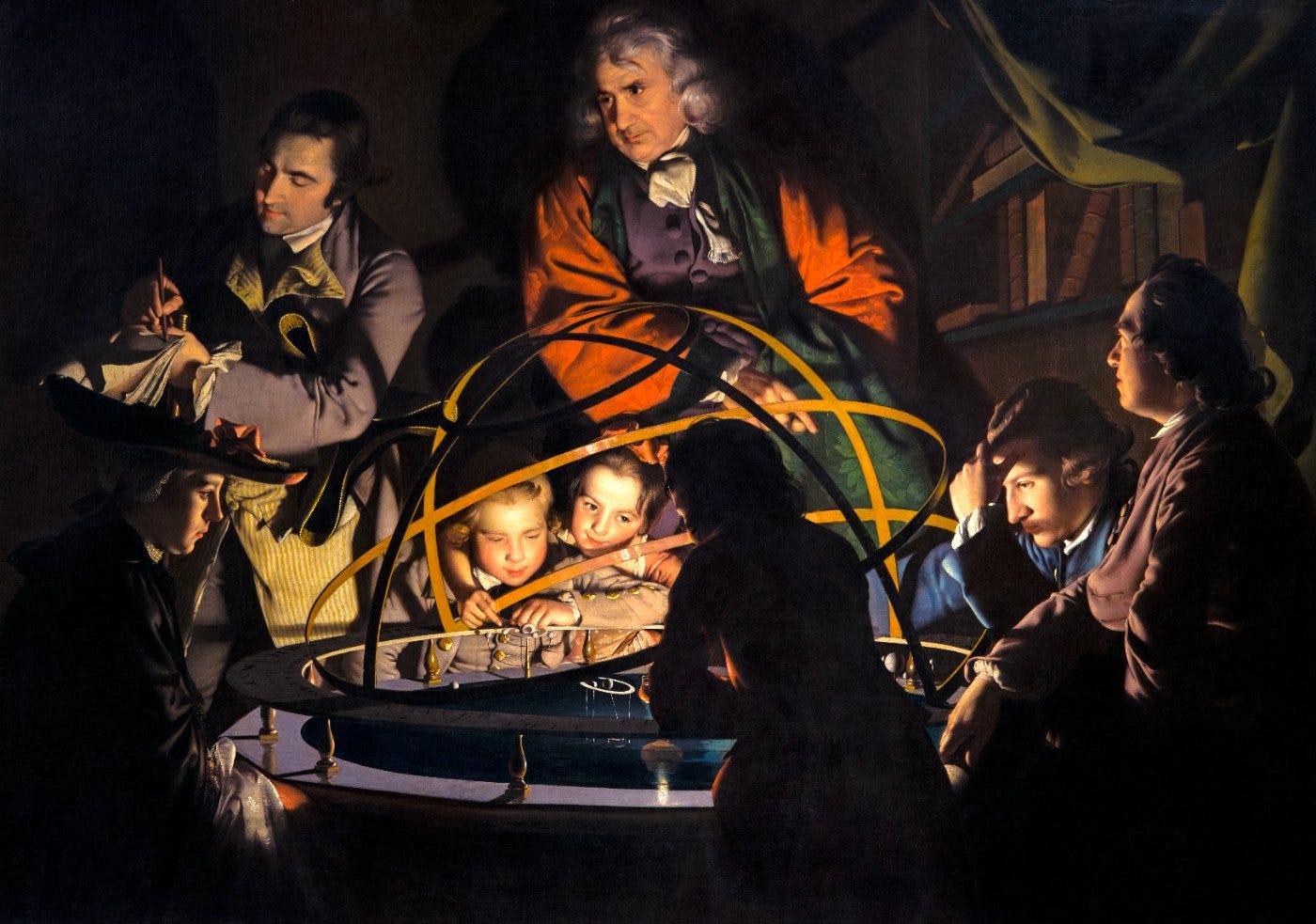
Joseph Wright was an English painter from the town of Derby, so everyone calls him Wright of Derby. Around 1766 he painted a dark room with a gadget in the middle. It’s an orrery, a brass clockwork model of the sun and planets. Turn a handle and the little worlds go round.
Where the sun should be, there’s a lamp. You can’t see it. A boy in the front has his back to us and blocks it. But you can see everything it touches.
Children lean over the rail with their faces glowing. A man at the side writes notes. A lecturer in a red robe explains how it all moves.
The machine sits in the middle of the room. It’s also the only thing there that doesn’t care what happens next.
The Order
About eighty years later, in 1843, a young mathematician named Ada Lovelace sat down with a machine that didn’t exist yet.
It was called the Analytical Engine. Her friend Charles Babbage, an English inventor, had designed it as a calculating machine you could give instructions to. He never finished building it.
An Italian engineer, Luigi Menabrea, had written an article about it in French. Lovelace translated it into English. Then she added her own notes, labeled A to G. They ended up far longer than the article itself.
In Note G she did something nobody had done before. She wrote out, step by step, how the machine could work out a tricky series of numbers that mathematicians use. Many people call it the first computer program.
She also wrote a warning. The Engine “has no pretensions whatever to originate anything. It can do whatever we know how to order it to perform.”
Read that second sentence again slowly. It’s a test, and it still works.
Can you write down the order for this task? Then a machine can carry it out. If you can’t, the machine waits for you.
To be fair, she doesn’t get the last word. In 1950 Alan Turing, the British mathematician who helped break German codes in the Second World War, pushed back on her. He thought machines could surprise us. Today’s tools do. They learn from piles of examples, and they produce things nobody ordered line by line.
But look at what still happens every time you open one. It sits there. Blinking. Waiting for you to want something.
The List
Here’s the thing to try this week.
Take one ordinary workday. Write every task on a sheet of paper, even the boring ones. Especially the boring ones.
Next to each task, ask Lovelace’s question. Could I write the order for this?
For a lot of them, you can. Format the report. Book the room. Turn these notes into a tidy email. Those are fair to hand over, and you can stop feeling guilty about it.
Then you’ll hit tasks where the order breaks down. You start writing “first do this” and end up writing “well, it depends.”
It depends on who’s asking. Or on what went wrong last time. Or on a feeling that the numbers look a little off.
Circle those.
Most of us were never paid for the circled parts, at least not on paper. They don’t appear in a job description. Nobody gives a prize for noticing the question no one asked. Yet those tasks decide what all the others are for.
Go back to the painting for a second. The lamp is the one thing Wright refused to show us. The boy’s dark shape covers it completely. And every bright face in the room is bright because of it.
Your circled tasks work the same way. They’re easy to miss and hard to replace, and they’re the ones a machine can only wait for.
Keep the sheet in a drawer. Pull it out in March and see how many circles you’ve added.

Roald Dahl wrote a story called The Great Automatic Grammatisator in 1953. It was about a nerd in a publishing company who literally created an AI system that would write in any style and help live authors by taking their simple plots and turning them into novels. Of course they were a bit mediocre compared to real writing, but cheap. Authors were all then asked to sign up to be part of it.
In the end, writing as an art was destroyed, and the few holdouts were left wondering where their next meal would come from.